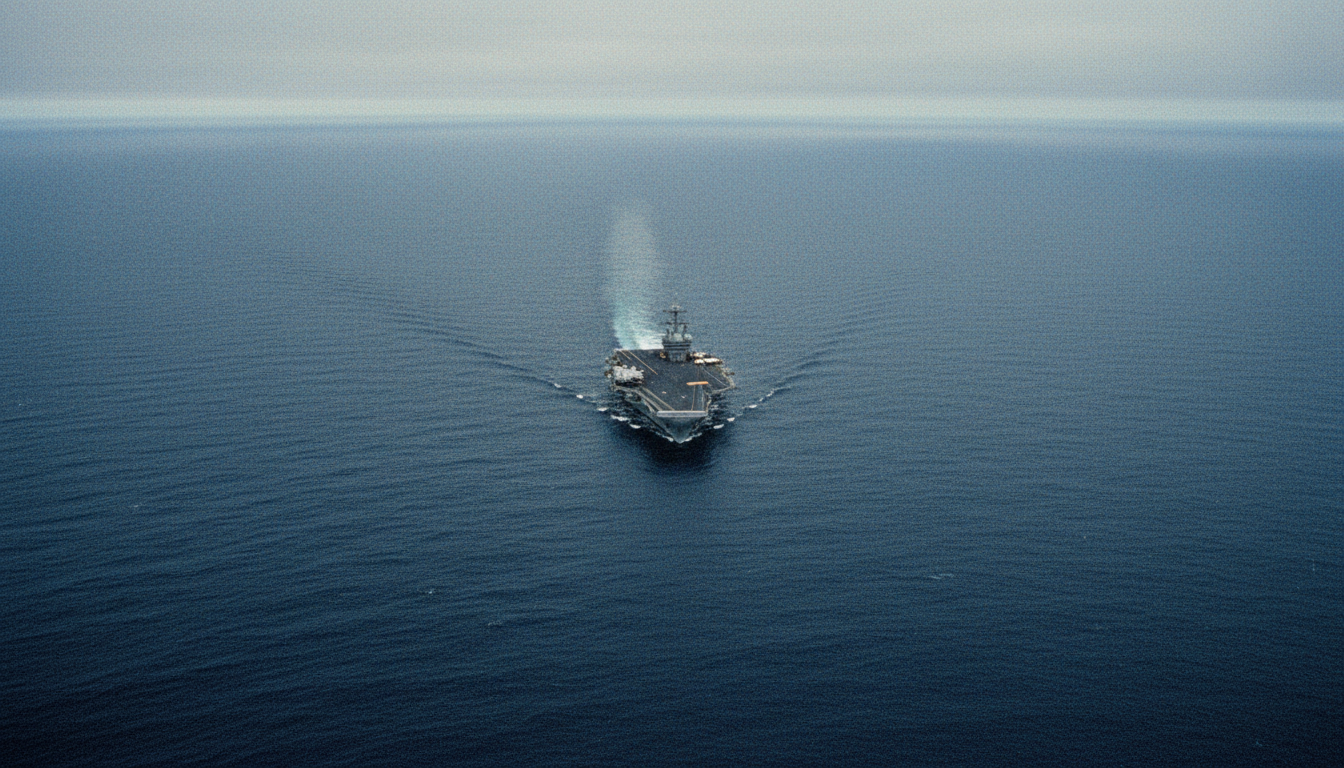
USS Nimitz 'Tic Tac' UAP Encounter (2004)
— EXECUTIVE SUMMARY
On November 14, 2004, U.S. Navy pilots encountered an unidentified, wingless, oblong object off the coast of Southern California that displayed flight capabilities beyond known technology. The incident, supported by radar data and infrared footage, remains one of the most significant and officially acknowledged UAP cases in military history.
The moment it began
On the morning of November 14, 2004, the Pacific Ocean off the coast of Southern California was calm, offering near-perfect visibility for the pilots of the USS Nimitz Carrier Strike Group. Commander David Fravor, then the Commanding Officer of Strike Fighter Squadron 41, known as the 'Black Aces,' was leading a routine training exercise. The weather was clear, with no cloud cover to obscure the horizon. Fravor and his wingman, Lt. Commander Alex Dietrich, were flying F/A-18F Super Hornets, expecting a standard day of air-to-air combat drills. However, the mission profile shifted abruptly when they checked in with the air defense controllers aboard the USS Princeton, an Aegis-class guided-missile cruiser. The controllers informed the pilots that their training was being suspended for 'real-world tasking.' For the previous two weeks, the Princeton’s advanced AN/SPY-1 radar systems had been tracking anomalous objects. These targets were observed descending from altitudes exceeding 80,000 feet—effectively space—to sea level in a matter of seconds, where they would hover for hours before ascending again. The pilots were vectored toward a specific set of coordinates, unaware of the nature of the contact they were about to intercept, marking the beginning of an encounter that would challenge the boundaries of modern aviation understanding.
What they saw
As Fravor and Dietrich approached the designated coordinates, they did not initially see another aircraft. Instead, they observed a disturbance on the ocean surface—a churning, cross-shaped pattern in an otherwise calm sea, as if something were hovering just beneath the surface. Above this white water, at an altitude of approximately 50 feet, sat a smooth, white, oblong object roughly 40 feet in length. It lacked wings, rotors, exhaust plumes, or any visible flight control surfaces. Fravor began a spiraling descent to get a closer look, while Dietrich remained in high cover to observe the interaction. As Fravor maneuvered his jet toward the object, it appeared to react, mirroring his movements and rising to meet him. When Fravor attempted to cut across the object's path to force an intercept, the craft demonstrated an instantaneous acceleration that defied conventional physics. It vanished from their visual field in less than two seconds, reappearing moments later on the Princeton’s radar at the carrier group’s Combat Air Patrol point, 60 miles away. The object had traversed that distance in under a minute, displaying performance capabilities that far exceeded any known military or civilian aircraft of the era.
The witnesses
The primary witnesses to this event were four highly trained naval aviators, including Commander David Fravor and Lt. Commander Alex Dietrich. Fravor, a seasoned pilot with an extensive career, has since provided sworn testimony to the U.S. Congress regarding the encounter. He described the object as a 'giant flying propane tank' that moved with an agility that was 'beyond anything I had ever seen in my career.' The air defense controller aboard the USS Princeton, Senior Chief Kevin Day, was instrumental in tracking the objects for the two weeks leading up to the encounter, providing the radar data that vectored the pilots to the scene. Another key witness, Lt. Chad Underwood, was launched on a subsequent sortie after Fravor’s flight returned to the Nimitz. Underwood was tasked with investigating the same radar contacts and managed to acquire the object on his jet's Advanced Targeting Forward-Looking Infrared (ATFLIR) pod. These individuals, all professionals with years of experience in identifying aircraft and atmospheric phenomena, remain consistent in their accounts, emphasizing the lack of any conventional propulsion or aerodynamic features on the object they observed.
The investigation
Following the encounter, the pilots returned to the USS Nimitz and reported what they had witnessed to their colleagues. Lt. Chad Underwood, who launched shortly after, successfully captured the infrared footage now famously known as the 'FLIR1' or 'Tic Tac' video. This footage shows the object maneuvering against the wind with no visible thermal exhaust signature, which would be expected from a jet engine or rocket. While the pilots expected a formal investigation, Fravor later testified to the House Oversight Committee that the incident was not treated with the rigor one might expect for such a significant event; he noted that his crew was not formally debriefed and that the radar tapes were never collected. Despite this, the data captured by the Princeton’s Aegis system and the ATFLIR pod provided a digital footprint of the event. The incident was eventually brought to the attention of the Pentagon’s Advanced Aerospace Threat Identification Program (AATIP), which was tasked with studying UAP, and has since been reviewed by the All-domain Anomaly Resolution Office (AARO), the current office responsible for investigating such phenomena.
The official record
For years, the details of the Nimitz encounter remained confined to military circles and anecdotal reports. This changed in April 2020, when the Department of Defense officially declassified and released the 'FLIR1' video, along with two other clips known as 'Gimbal' and 'GoFast.' In its official statement, the Department of Defense confirmed the authenticity of the footage and acknowledged that the aerial phenomena captured remain officially 'unidentified.' The official record acknowledges that the objects were tracked by multiple systems, including the USS Princeton’s radar, the Nimitz’s radar, and the E-2C Hawkeye’s systems. However, much of the raw data—including the specific radar tapes that Fravor claims showed the object jamming the aircraft's APG-73 radar—remains outside the public domain. The government has maintained a position of transparency regarding the existence of the videos while simultaneously stating that the nature and origin of the objects remain unknown. The lack of a comprehensive, public-facing report detailing the full scope of the radar data and the subsequent internal analysis leaves a significant gap in the official historical record of the event.
The arguments
Skeptical explanations for the Nimitz encounter have been numerous, ranging from sensor glitches and radar spoofing to the misidentification of conventional aircraft or weather balloons. Some critics argue that the 'Tic Tac' was merely a drone or a classified prototype being tested in the area, though this fails to account for the reported performance characteristics, such as the instantaneous acceleration and the lack of any visible propulsion system. Others suggest that the pilots may have been influenced by the radar data provided by the Princeton, leading to a psychological priming effect. However, these arguments struggle to reconcile the fact that the object was observed visually by four trained pilots who were close enough to describe its shape and lack of wings. Furthermore, the infrared footage shows an object that does not emit the heat signature of a jet engine, which contradicts the theory that it was a standard aircraft. While sensor artifacts can occur, the combination of visual confirmation and multi-platform radar tracking makes the 'glitch' hypothesis difficult to sustain for the entire duration of the two-week period during which the objects were tracked.
Where the case stands today
Today, the 2004 Nimitz encounter stands as the most credible and well-documented UAP case in modern history. It serves as a cornerstone for the ongoing national conversation regarding Unidentified Anomalous Phenomena and the necessity for government transparency. The case has moved from the fringes of fringe science into the halls of Congress, where it has been the subject of formal hearings and oversight. The persistence of the case is due to the high caliber of the witnesses and the corroborating sensor data that the Department of Defense has verified. It remains a focal point for the All-domain Anomaly Resolution Office (AARO) as they continue to analyze historical and contemporary reports. The Nimitz incident matters because it challenges our current understanding of aerospace technology and forces a re-evaluation of how the military handles anomalous data. Whether the object was a foreign adversary's breakthrough technology, a secret domestic project, or something else entirely, the fact that it operated with impunity within a U.S. military training range remains a significant national security concern that continues to demand rigorous scientific and governmental scrutiny.
— CHAIN OF CUSTODY: SOURCES & FURTHER READING
— FIELD REPORTS (0)
Sign in to post a field report.
No field reports yet. Be the first to contribute.
DISCLAIMER: Every story on this site is based on documented real-world reports or official records. We do not publish fiction. All sources are cited above.