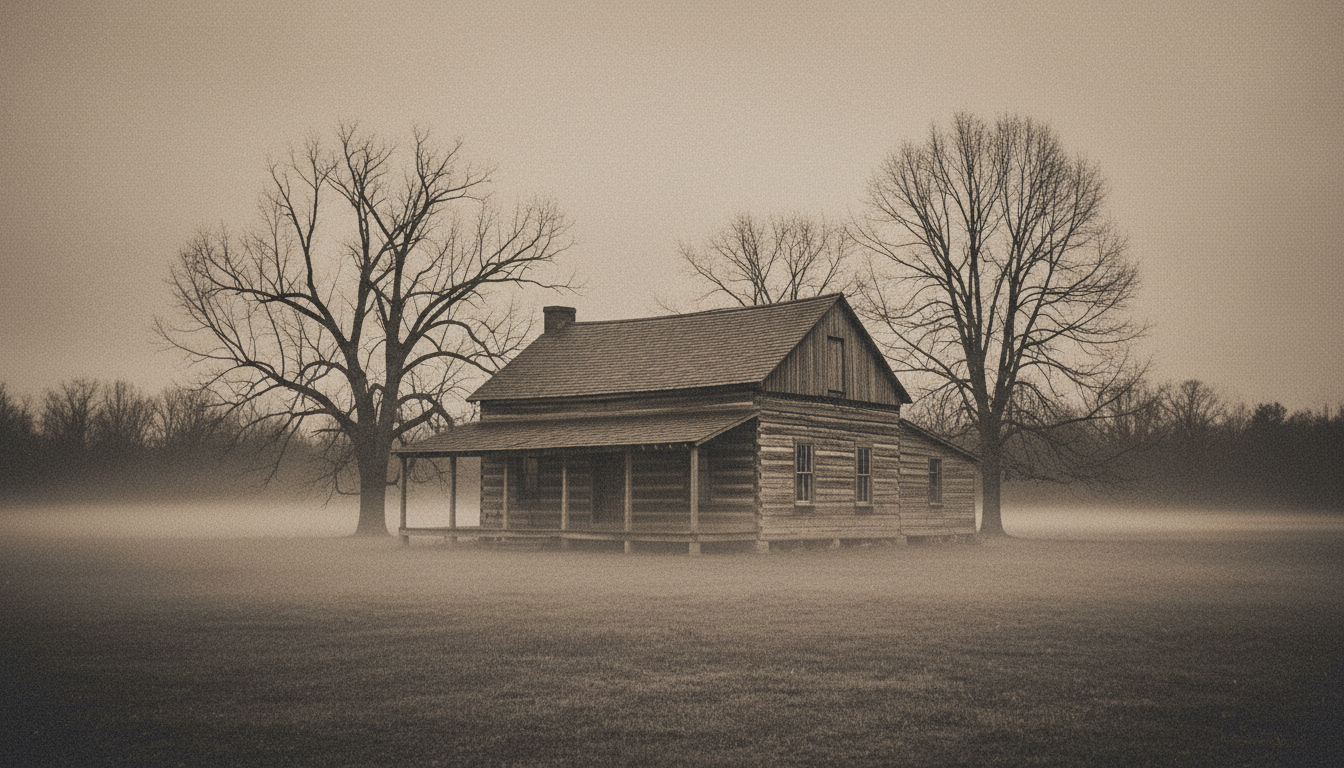
The Bell Witch Haunting (1817–1821)
— EXECUTIVE SUMMARY
The Bell Witch haunting remains one of the most enduring and documented poltergeist cases in American history, spanning from 1817 to 1821 in Robertson County, Tennessee. The entity, known as 'Kate,' tormented the family of John Bell Sr. with physical violence and audible communication, culminating in the patriarch's mysterious death.
The moment it began
In the late summer of 1817, the quiet, agrarian life of John Bell Sr. and his family in Robertson County, Tennessee, was irrevocably shattered. John Bell, a prosperous farmer who had migrated from North Carolina in 1804, was walking through his cornfield near the Red River when he encountered a strange, unidentifiable animal. The creature, which some accounts described as a dog-like entity, vanished as soon as Bell attempted to confront it. This initial sighting was merely the precursor to a series of disturbances that would soon plague the homestead. Within weeks, the family began hearing inexplicable knocking and scratching sounds emanating from the walls and doors of their home. As the autumn nights grew colder, the disturbances escalated from mere auditory annoyances to physical intrusions. The family, including John’s wife Lucy and their children, found themselves in a state of constant, mounting dread. The atmosphere on the farm, once defined by the rhythms of rural labor, shifted into a theater of the unknown, marking the beginning of what the family would later refer to as 'Our Family Trouble.'
What they saw
What distinguished the Bell Witch case from typical folklore was the entity's apparent intelligence and malevolence. The manifestations were not merely spectral; they were tactile and aggressive. According to contemporary accounts, an invisible force began pulling bed covers off sleeping family members, leaving them exposed to the night air. The entity, which eventually identified itself as 'Kate,' focused its hostility on the Bell children, particularly young Betsy Bell. She was frequently slapped, scratched, and pinched by unseen hands. The entity possessed a clear, audible voice, capable of carrying on complex conversations, demonstrating an unsettling knowledge of distant events, and even reciting Bible scripture with uncanny precision. The haunting was not confined to a single room; the entity displayed the ability to be in multiple places at once, tormenting the family with a relentless, mocking presence. The physical environment of the home was constantly disrupted, with furniture overturned and household items displaced, creating an environment of total psychological and physical siege that lasted for four years.
The witnesses
The witnesses to these events were not merely the Bell family, but a wide array of neighbors and visitors who traveled from across Tennessee and neighboring states to experience the phenomena. Among the most notable was General Andrew Jackson, who, according to legend, visited the farm in 1819 with a party of men. While accounts of his visit vary, it is widely reported that his party was so overwhelmed by the invisible force that they were forced to retreat. The family consulted local figures, including preachers James Johnson and Sugg Fort, who were tasked with interpreting the nature of the entity. The entity itself claimed to be the spirit of a neighbor, Kate Batts, and responded favorably to that name. The testimony of these witnesses, many of whom were respected members of the community, provided the foundation for the accounts later compiled by Martin V. Ingram. These individuals, ranging from skeptical observers to terrified family members, documented a consistent pattern of behavior that defied the rational explanations of the early 19th century.
The investigation
While modern forensic tools were unavailable, the investigation into the Bell Witch was conducted through the lens of 19th-century inquiry. Visitors and family members attempted to 'measure' the entity by challenging it with questions, testing its knowledge of distant events, and observing its physical reactions to their presence. General Jackson’s visit served as a form of field investigation, where he and his men attempted to draw out the spirit, only to be met with ridicule and physical manifestations that defied their military discipline. The family also sought medical and spiritual counsel, with doctors like George B. Hopson examining the physical evidence left behind, such as the mysterious vial of dark liquid found near John Bell’s bedside. When this liquid was administered to a cat, the animal died within seconds, providing a grim, empirical data point that the family and their associates used to link the entity to the patriarch's declining health. These efforts, while primitive by modern standards, represented a serious attempt to quantify and understand an entity that refused to conform to natural laws.
The official record
There is no singular 'official' government file on the Bell Witch, as the events predated modern paranormal investigative agencies. However, the historical record is anchored by 'An Authenticated History of the Famous Bell Witch,' published in 1894 by Martin V. Ingram. This work, compiled from the diary of Richard Williams Bell—John’s son—and contemporary testimony, remains the primary source for the case. The Tennessee State Library and Archives and the Library of Congress hold various historical records that corroborate the existence of the Bell family and the widespread nature of the legend in the 19th century. Much of the 'official' narrative is derived from these public domain documents, which detail the legal and social standing of the Bell family, including John Bell’s excommunication from the local Baptist Church. While some details, such as the original diary of Richard Williams Bell, have never surfaced, the consistency of the accounts across various historical society records provides a robust, if haunting, documentation of the period.
The arguments
Skeptics have long sought to explain the Bell Witch through naturalistic lenses. Some suggest that the haunting was a manifestation of mass hysteria or a complex hoax orchestrated by the family to gain attention or to mask internal domestic strife. Others point to the possibility of geological phenomena or even the presence of a disgruntled neighbor, such as the real-life Kate Batts, whose reputation may have been unfairly maligned by the legend. However, these arguments often struggle to account for the sheer volume of independent witnesses who reported similar experiences over a four-year period. The physical evidence, such as the poisoned cat and the specific, accurate knowledge of distant events, remains difficult to dismiss as mere trickery. While the lack of a contemporary, non-partisan scientific report leaves room for doubt, the persistence of the accounts and the lack of a clear motive for such a prolonged, self-destructive hoax continue to challenge those who seek to reduce the case to a simple psychological or social aberration.
Where the case stands today
Today, the Bell Witch remains one of the most detailed and widely attested poltergeist cases in American history. The site of the farm in Adams, Tennessee, is marked by a state historical marker, and the story continues to be a subject of intense interest for historians, folklorists, and paranormal researchers alike. The case matters because it serves as a bridge between the frontier history of Tennessee and the enduring human fascination with the unexplained. It is not merely a ghost story; it is a documented episode of community trauma that forced 19th-century citizens to confront the limits of their understanding. Whether one views the Bell Witch as a genuine supernatural manifestation or a profound psychological event, the story persists because it refuses to be fully explained or forgotten. It remains a 'who-done-it' mystery that continues to invite new generations to examine the evidence, visit the site, and ponder the possibility that some events in history simply defy the boundaries of the known world.
— CHAIN OF CUSTODY: SOURCES & FURTHER READING
— FIELD REPORTS (0)
Sign in to post a field report.
No field reports yet. Be the first to contribute.
DISCLAIMER: Every story on this site is based on documented real-world reports or official records. We do not publish fiction. All sources are cited above.