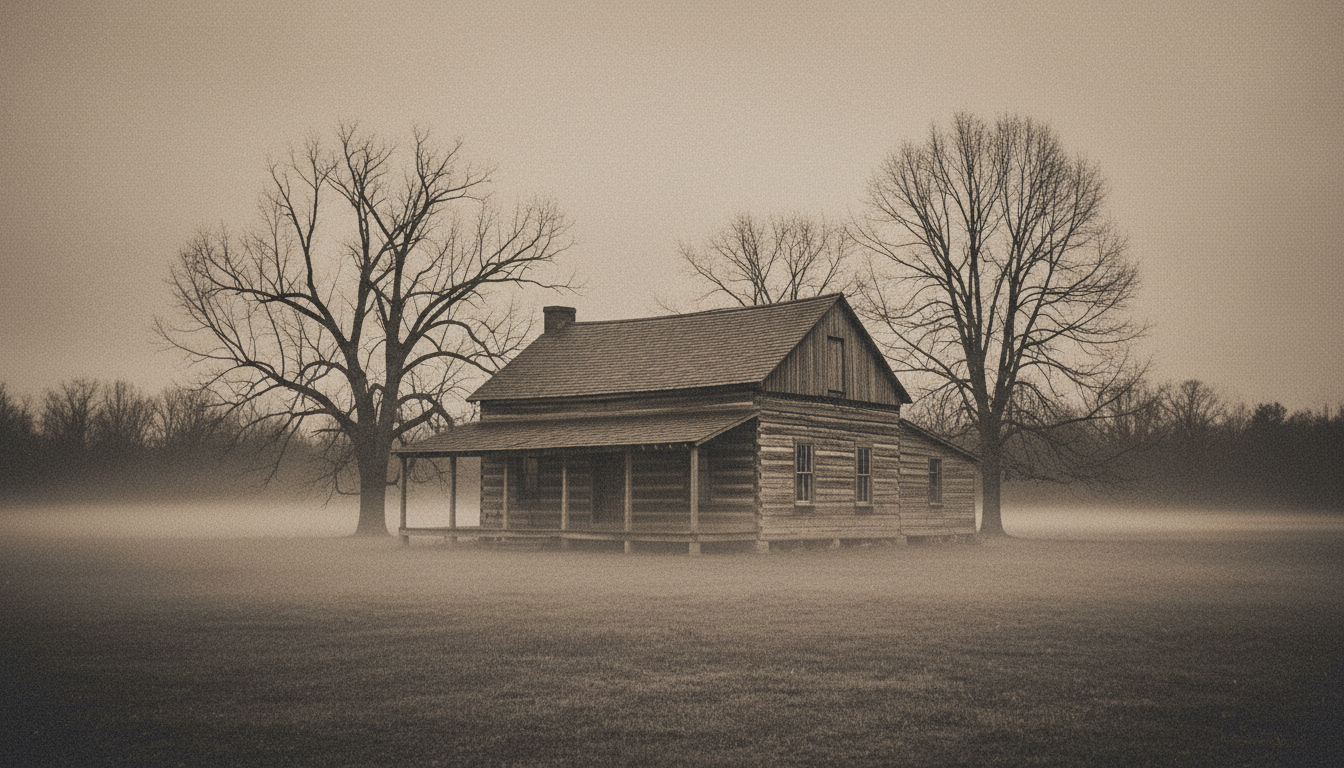
The 1920s Spooklight Phenomenon
— EXECUTIVE SUMMARY
The Joplin Spooklight is a century-old atmospheric phenomenon involving mysterious glowing orbs along the Missouri-Oklahoma border. Despite extensive scientific investigations and debunking efforts, it remains a persistent fixture of American folklore.
The moment it began
It was the 1920s, a decade defined by rapid modernization and the creeping expansion of the automobile, when the rural landscape near Joplin, Missouri, began to yield a secret that would haunt the local consciousness for a century. As the sun dipped below the horizon, casting long, jagged shadows across the Ozark hills, residents and travelers alike found themselves drawn to a quiet, unassuming stretch of gravel known as the 'Spooklight Road.' The air was thick with the humidity of the Midwestern summer, heavy with the chorus of crickets and the scent of damp earth. It was during these dark, moonless hours—typically between 10:00 p.m. and midnight—that the silence of the countryside was broken not by the rumble of engines, but by the appearance of something altogether more ethereal. Witnesses, often standing in the cool night air, would watch as a ball-shaped orb, varying in color from a soft, pale yellow to a piercing, fiery orange, manifested in the distance. It did not behave like a lantern or a torch; it danced, flickered, and bobbed with a rhythmic, almost sentient grace, moving from east to west along the horizon. For those early observers, the experience was visceral, a sudden intrusion of the inexplicable into the mundane reality of rural life.
What they saw
Those who stood on the gravel of the Devil’s Promenade, as the road was colloquially known, described the event with a consistency that defied easy dismissal. The light would emerge as a singular, glowing entity, hovering just above the tree line or skipping along the contours of the fields. It was not a static glow; it possessed a dynamic quality, darting in and out of view, sometimes expanding in brightness before contracting into a pinpoint of intense luminescence. Witnesses reported that the orb would occasionally drift toward them, only to vanish abruptly when approached or when the observer attempted to close the distance. The movement was described as fluid, lacking the mechanical rigidity of a vehicle, yet it maintained a trajectory that suggested a deliberate path. Some observers claimed to see the light hover above the trees, while others swore it zipped overhead or darted in and out of the path of their own vehicles. The phenomenon was not merely a visual trick; it was an event that commanded attention, forcing the observer to question the boundaries of their own perception as the orb pulsed against the backdrop of the pitch-black Ozark night.
The witnesses
Throughout the decades, the witnesses were as varied as the stories they told. They were farmers who had lived on the land for generations, teenagers seeking a rite of passage, and curious tourists drawn by the growing reputation of the 'Tri-State Spooklight.' Among the most dedicated were the locals who grew up with the legend, such as Charles Dawes, whose family resided on E 40 Road and who claimed to have seen the light a thousand times, treating it with the casual familiarity of a neighbor. Others were less composed. There were those who knocked on doors in the dead of night, frantic and disoriented, having chased the light until it vanished into the brush. The accounts were often deeply personal; some witnesses, like a retired Air Force colonel and physicist who visited the area, reported seeing the light well below the highway crest, moving on both sides of the road in a manner that defied his professional training. These individuals, ranging from the skeptical to the superstitious, all shared a common thread: the inability to reconcile what they witnessed with the rational world they inhabited, leaving them to grapple with the lingering, unsettling memory of the glow.
The investigation
As the legend grew, so did the desire to strip away the mystery through the lens of science. The investigation of the Spooklight became a collaborative effort between local enthusiasts and outside experts. In the mid-20th century, figures like Major Thomas Sheard of Camp Crowder near Neosho, Missouri, took a methodical approach. Armed with an engineer’s transit, a telescope, and walkie-talkies, Sheard surveyed the terrain, attempting to triangulate the origin of the lights. He utilized an airplane to map the line-of-sight between Spooklight Road and the surrounding geography. Other efforts were equally rigorous; researchers stationed signal lights on roads thirteen miles away to test if the phenomenon was merely a reflection or a trick of the light. In 1955, a scientific safari from a Shawnee Mission, Kansas, high school conducted extensive visual observations throughout the night, though they failed to capture the elusive orb. Even the Ghost Research Society, as recently as 2022, deployed teams to the site, utilizing modern equipment to document the area, yet they, like their predecessors, found themselves empty-handed, unable to replicate the conditions that birthed the legend.
The official record
Despite the fervor surrounding the Spooklight, the official record remains frustratingly sparse and contradictory. While local folklore flourished, institutional documentation was often non-existent or dismissive. For instance, when inquiries were made regarding the involvement of the U.S. Army Corps of Engineers, the response from the Tulsa District was one of total denial; Chief of Public Affairs John O. Thisler stated in 1983 that the Corps had never conducted any investigation into the phenomenon, despite persistent rumors to the contrary. This discrepancy between the public’s belief in 'official' studies and the reality of bureaucratic records highlights the gap between the legend and the archive. The phenomenon was never classified as a security threat, nor was it ever formally acknowledged by state or federal geological surveys as a natural anomaly. Instead, it remained a 'ghost' in the records—a subject of intense public interest that left no paper trail in the halls of government, leaving the mystery to exist entirely within the realm of private observation and local, unverified reports.
The arguments
The debate over the Spooklight’s origin has been polarized for decades. Skeptics, pointing to the work of journalists like A.B. MacDonald, who wrote in the Kansas City Star as early as 1936, argue that the light is nothing more than the misidentification of distant car headlights on Route 66. This theory suggests that the topography creates a visual effect where headlights, miles away, appear to bounce and dance due to atmospheric refraction or the curvature of the land. Experiments involving colored cellophane over car lights have successfully demonstrated that observers on Spooklight Road can indeed see these signals. However, believers and some researchers argue that this explanation is insufficient. They point to the fact that sightings were reported long before the advent of the automobile or the construction of the highway. Furthermore, witnesses like the retired Air Force colonel argue that the movement of the light—appearing below the crest of the road and in locations where no road exists—cannot be explained by simple headlight reflection. The argument remains a stalemate: one side relies on the physics of light and distance, while the other relies on the lived experience of those who claim to have seen something that defies such simple categorization.
Where the case stands today
Into the 21st century, the Spooklight remains an enduring, if elusive, element of American folklore. It continues to draw tourists, paranormal investigators, and the merely curious to the dark, gravel roads of the Missouri-Oklahoma border. The site has seen the rise and fall of museums, such as the one operated by Garland 'Spooky' Middleton, which once served as a hub for those seeking to understand the mystery. Today, the Spooklight serves as a testament to the human fascination with the unexplained. It matters not because it has been solved, but because it has not. It represents a bridge between the past and the present, a story that has been passed down through generations, evolving with the times while retaining its core of mystery. Whether it is a trick of the light, a geological anomaly, or something more profound, the Spooklight persists as a reminder that even in an age of total information, there are still corners of the world where the truth remains just out of reach, dancing in the dark.
— CHAIN OF CUSTODY: SOURCES & FURTHER READING
— FIELD REPORTS (0)
Sign in to post a field report.
No field reports yet. Be the first to contribute.
DISCLAIMER: Every story on this site is based on documented real-world reports or official records. We do not publish fiction. All sources are cited above.