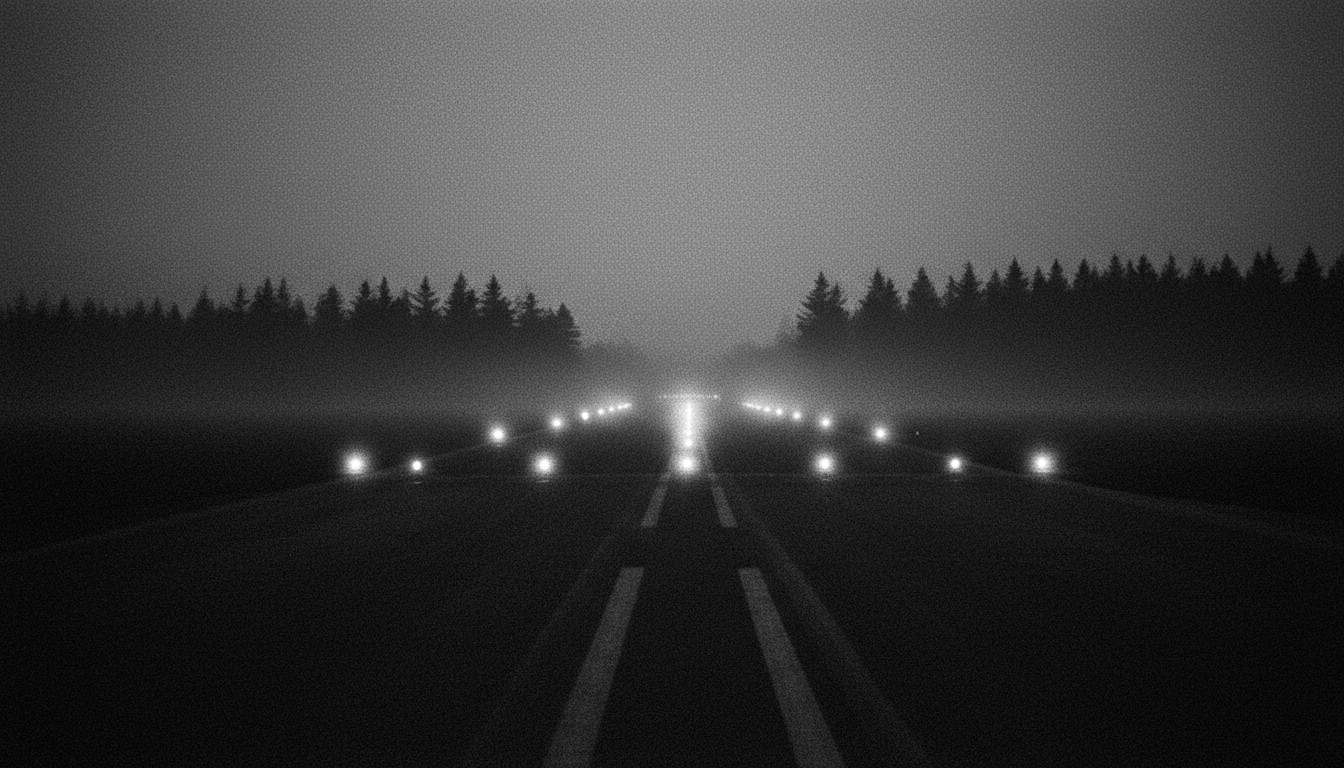
The 1951 Washington, D.C. UFO Incident
— EXECUTIVE SUMMARY
The 1952 Washington, D.C. UFO incident remains one of the most significant mass sightings in American history, involving multiple radar detections and visual reports over the nation's capital. Despite extensive investigations by the U.S. Air Force's Project Blue Book, the events remain a subject of intense debate and public fascination.
The moment it began
On the humid, sweltering night of July 19, 1952, the atmosphere in Washington, D.C. was heavy with the typical summer heat, but the air traffic control center at Washington National Airport was about to experience a shift that would defy conventional explanation. At approximately 11:40 PM, air traffic controller Edward Nugent was monitoring the radar scopes when he noticed seven unidentified targets appearing on his screen. These objects were not following any established flight paths, nor were they responding to standard identification protocols. The location of these blips was approximately 15 miles southwest of the airport, hovering in restricted airspace that should have been entirely clear of civilian or military traffic. The night was clear, and the radar equipment was functioning within normal parameters, yet the presence of these targets suggested an intrusion that was both immediate and inexplicable. As the minutes ticked by, the tension in the tower grew palpable. Nugent, realizing the gravity of the situation, alerted his supervisor, Harry Barnes, who immediately initiated a verification process to ensure the radar was not suffering from a technical malfunction. The quiet routine of a Saturday night in the capital had been shattered, replaced by the cold, blinking reality of unidentified objects encroaching upon the heart of the United States government.
What they saw
Following the initial detection, the situation escalated rapidly. Harry Barnes, seeking to confirm the anomaly, had two other controllers verify the radar data, and they confirmed that the equipment was operating perfectly. Barnes then contacted the radar-equipped control tower at the same airport, where controllers Howard Cocklin and Joe Zacko reported seeing the same unidentified blips on their own screens. The objects displayed flight characteristics that were entirely alien to the aviation technology of the era. They were observed moving at varying speeds, sometimes hovering motionless before accelerating at incredible velocities that would have been impossible for conventional aircraft to sustain without structural failure. The radar returns showed the objects moving in erratic patterns, darting across the sky and occasionally congregating over the restricted airspace of the U.S. Capitol and the White House. When military interceptors were eventually scrambled from nearby bases to investigate, the objects seemed to react to their presence. According to reports, whenever the fighter jets approached the coordinates of the blips, the objects would vanish from the radar screens, only to reappear once the jets had departed the area. This cat-and-mouse game continued throughout the night, leaving controllers and pilots baffled by the apparent intelligence behind the movements.
The witnesses
The witnesses to this event were not casual observers, but trained professionals whose careers depended on their ability to accurately interpret radar data and visual cues. Edward Nugent, the controller who first spotted the targets, was joined by his supervisor Harry Barnes, a man with years of experience in air traffic management. Their testimony was corroborated by Howard Cocklin and Joe Zacko, who were stationed in the control tower and witnessed the same anomalies on their equipment. These men were accustomed to the routine of tracking commercial and military flights; they knew the difference between a weather phenomenon, a bird, and a solid, metallic object. Their documented accounts emphasize the precision of the radar returns and the impossibility of the objects being mere ghosts or electronic noise. Beyond the tower, the incident drew the attention of military personnel and eventually the public. Albert M. Chop, the civilian press spokesman for Project Blue Book, was among those who arrived at the airport to witness the unfolding drama. His presence underscored the seriousness with which the military treated the event, as he was tasked with managing the inevitable media fallout. The witnesses were consistent in their descriptions: these were not hallucinations, but physical entities that challenged the boundaries of known aeronautical capabilities.
The investigation
In the wake of the sightings, the U.S. Air Force launched a formal investigation under the auspices of Project Blue Book, the military's long-running study of unidentified aerial phenomena. Captain Edward Ruppelt, the head of Project Blue Book, took personal charge of the inquiry. The investigation was comprehensive, involving the analysis of radar logs, interviews with the controllers at Washington National Airport, and debriefings of the pilots who had been scrambled to intercept the objects. The military also coordinated with intelligence agencies to determine if the objects could be of foreign origin, specifically Soviet, given the height of the Cold War. The radar data was scrutinized for any signs of equipment failure or atmospheric interference. Investigators looked for evidence of temperature inversions—a phenomenon where layers of air of different temperatures can cause radar beams to bend and create false returns. However, the consistency of the reports across multiple radar systems and the visual confirmation by pilots made the simple explanation of atmospheric error difficult to sustain. The investigation was not merely a technical review; it was a high-stakes effort to maintain national security and public order in an era of extreme paranoia regarding potential aerial threats.
The official record
Despite the intensity of the investigation, the official record remains frustratingly inconclusive. Project Blue Book’s final determination, as documented in their files, concluded that the radar contacts were likely caused by temperature inversions, which produced anomalous radar propagation. This explanation, however, was met with significant skepticism from the very people who had tracked the objects. The official reports often omitted or downplayed the more bizarre aspects of the sightings, such as the objects' ability to evade interceptors and their presence over the most sensitive government buildings in the country. Much of the data was classified, and the military was careful to manage the narrative to prevent public panic. While the Air Force officially categorized the incident as a series of misidentified natural phenomena, the internal documents reveal a much higher level of concern than was ever shared with the public. The files indicate that the military was deeply worried about the possibility of foreign technology, yet they could find no evidence of a conventional aircraft that could perform the maneuvers described. The lack of a definitive, publicly accepted explanation has left the incident as one of the most prominent "unidentified" cases in the history of the U.S. government.
The arguments
Skeptics have long argued that the Washington, D.C. incident was a classic case of mass hysteria fueled by the media and the limitations of 1950s radar technology. The primary argument for this perspective is the temperature inversion theory, which suggests that the radar blips were not solid objects but rather reflections of ground-based signals caused by the unique atmospheric conditions of that July night. Proponents of this view point out that radar technology at the time was prone to such errors and that the "erratic" movements were simply the result of the radar beam bouncing off different layers of air. However, this explanation fails to account for the visual sightings reported by pilots and the fact that the blips appeared on multiple, independent radar systems simultaneously. Critics of the official explanation argue that if it were merely a weather phenomenon, it would not have consistently "vanished" when interceptors approached, nor would it have been so localized over the capital. The debate continues to hinge on whether the radar data represents a physical reality or a technical failure, with neither side able to provide a smoking gun that satisfies the other.
Where the case stands today
Today, the 1952 Washington, D.C. incident stands as a cornerstone of UAP research and a symbol of the ongoing struggle for government transparency. It is frequently cited in discussions about the history of unidentified aerial phenomena and the evolution of the military's approach to such sightings. The case remains important because it involved multiple, highly credible witnesses and was captured on radar, providing a level of evidence that is rare in the field of ufology. While the Air Force has long since closed the book on the incident, the public interest has never waned, with the event being featured in documentaries, books, and even television series. It serves as a reminder of the limitations of our understanding of the skies and the persistent questions that remain about what exactly was hovering over the nation's capital. The incident continues to be a focal point for those who believe that the government has more information than it has disclosed, and it remains a pivotal moment that helped shape the modern debate surrounding UAPs. As we continue to study the skies with more advanced technology, the Washington incident remains a benchmark against which all other sightings are measured, a testament to the enduring mystery of the unknown.
— CHAIN OF CUSTODY: SOURCES & FURTHER READING
— FIELD REPORTS (0)
Sign in to post a field report.
No field reports yet. Be the first to contribute.
DISCLAIMER: Every story on this site is based on documented real-world reports or official records. We do not publish fiction. All sources are cited above.