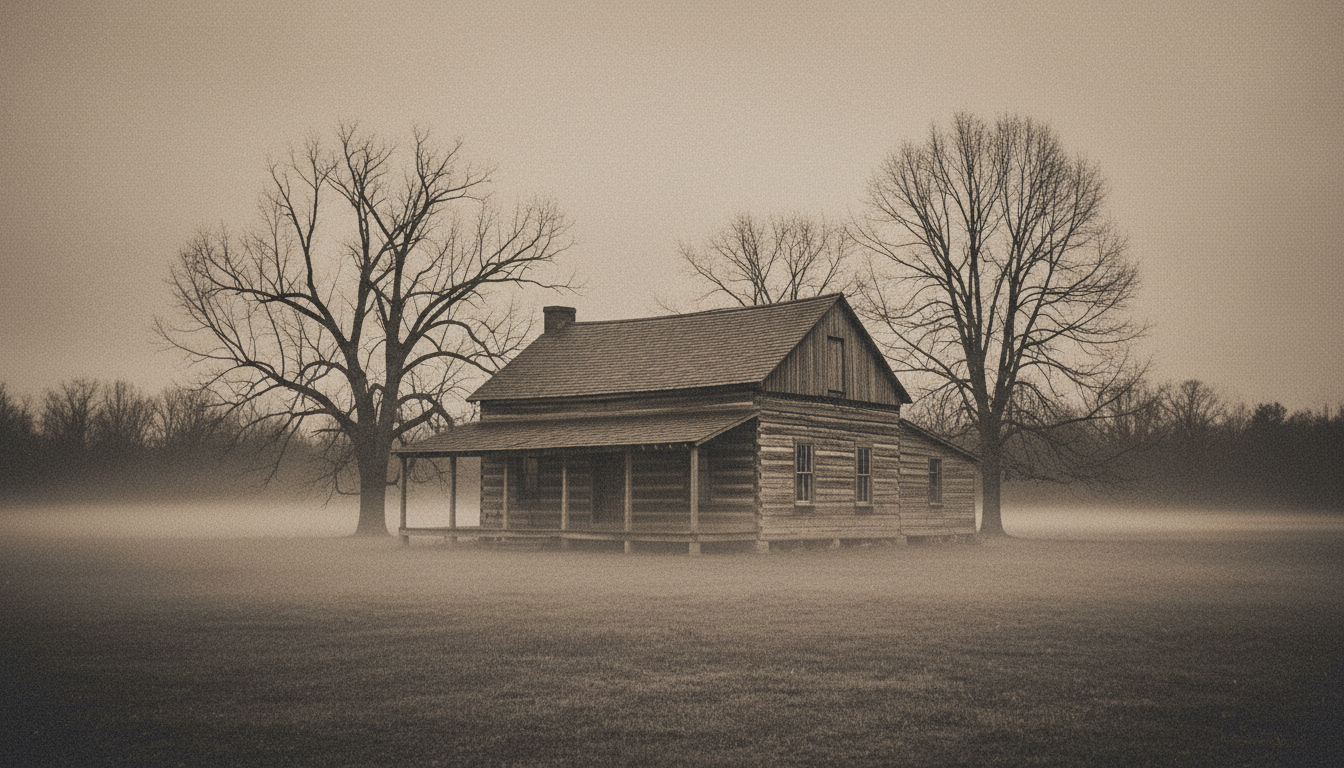
The 1848 Hydesville Conjuring Case
— EXECUTIVE SUMMARY
The 1848 Hydesville incident involving the Fox sisters ignited the global Spiritualist movement by claiming communication with a murdered peddler through mysterious rapping sounds. This narrative explores the origins, investigations, and enduring legacy of the case that fundamentally altered 19th-century American spiritual discourse.
The moment it began
On the night of March 31, 1848, the atmosphere in the modest, rented cottage in Hydesville, New York, was thick with an unsettling, palpable tension. The Fox family—John, Margaret, and their two youngest daughters, Kate, aged eleven, and Maggie, aged fourteen—had been enduring a series of inexplicable disturbances for several days. The house, which had previously served as a temporary residence for various tenants, seemed to have turned against its inhabitants. As the sun dipped below the horizon and the rural New York darkness enveloped the small structure, the family prepared for bed, hoping for a reprieve from the persistent, rhythmic knocking that had plagued their nights. The weather outside was typical for the season, yet inside, the air felt heavy and charged. The girls, exhausted by the previous nights of sleeplessness, were tucked into their beds, but the silence was short-lived. Suddenly, the sharp, percussive sounds returned, echoing through the wooden walls of the bedroom. It was not merely a random noise; it was a deliberate, intelligent response to the environment. The girls, rather than cowering in fear, began to challenge the unseen presence, marking the precise moment that would eventually be recognized as the birth of modern American Spiritualism. The family was gathered in the small, cramped quarters, their lives about to be irrevocably changed by what they perceived as a dialogue with the beyond.
What they saw
What transpired that night was a sequence of events that defied the conventional understanding of physics and reality. According to historical accounts, the girls began to snap their fingers, challenging the source of the noise to mimic them. To their astonishment, the rapping sounds—described as distinct, sharp knocks—perfectly mirrored the rhythm of their fingers. Maggie, with a boldness that belied her youth, called out to the unseen entity, asking it to repeat the number of raps corresponding to the ages of her siblings. The entity complied with chilling accuracy. The communication evolved rapidly; the girls established a code where raps would signify 'yes' or 'no' to specific questions. They soon learned that the entity claimed to be the spirit of a peddler who had been murdered in the house five years prior. The sounds were not merely auditory; they were felt as vibrations in the floorboards and furniture. As the night progressed, the sisters continued their interrogation, moving from simple counting to complex inquiries about the identity and fate of the spirit. The sequence of events was methodical, leaving the parents in a state of profound shock as they witnessed their daughters seemingly bridging the gap between the living and the dead, a phenomenon that would soon draw the attention of the entire community.
The witnesses
Word of the 'Hydesville rappings' spread with remarkable speed, drawing neighbors and curious onlookers to the Fox cottage. Among the early witnesses were local residents who were initially skeptical, expecting to find a mundane explanation for the disturbances. However, as they observed the sisters in action, their skepticism often gave way to bewilderment. The community members, including family friends and local farmers, documented their experiences, noting that the raps occurred in various parts of the room, seemingly independent of the girls' physical movements. One neighbor, who had been familiar with the house's history, noted the chilling specificity of the information provided by the raps. The witnesses were not merely passive observers; they actively participated in the sessions, asking their own questions and receiving what they interpreted as coherent, intelligent responses. These documented accounts, often recorded in letters and local journals, provided the foundational evidence for the claims. The witnesses, ranging from simple laborers to more educated townsfolk, were united by the shared experience of witnessing something they could not explain through natural means. Their testimonies, while subjective, created a collective narrative that transformed a private family disturbance into a public phenomenon, setting the stage for the broader Spiritualist movement that would soon sweep across the nation.
The investigation
As the fame of the Fox sisters grew, the cottage became a site of intense scrutiny. Various individuals, including those with scientific or religious backgrounds, sought to investigate the source of the sounds. They examined the floorboards, the walls, and the furniture, looking for hidden mechanisms, wires, or mechanical devices that could produce such rhythmic rapping. Despite these efforts, no physical evidence of trickery was found during the initial period of the phenomenon. Investigators attempted to control the environment, asking the girls to stand on pillows or to place their hands in specific positions to rule out the possibility of them creating the sounds with their own bodies. The 'investigation' was largely informal, conducted by neighbors and local enthusiasts rather than formal scientific bodies, yet it was rigorous in its own way. They measured the timing of the raps, tested the consistency of the responses, and even attempted to communicate with the spirit themselves. The lack of a definitive, material explanation during these early investigations only served to bolster the belief that the phenomena were indeed of a paranormal nature, fueling the public's fascination and the growing demand for more demonstrations.
The official record
While no formal government report exists for the 1848 incident, the historical record is preserved through contemporary newspaper accounts and later investigations into the property. The New York Times, in its historical archives, documents the subsequent discovery of a headless skeleton beneath the cellar of the Fox home, which many interpreted as the remains of the murdered peddler, Charles Rosna. This discovery, made years after the initial events, provided a grim, material anchor to the sisters' claims. The official record, as it stands in historical archives, is a collection of sworn statements, newspaper reports, and the later, controversial confessions of the sisters themselves. Much of the 'official' narrative remains shrouded in the ambiguity of the 19th century, where the line between journalism and sensationalism was often blurred. The files, including those held by the Library of Congress, highlight the cultural impact of the event rather than providing a scientific verdict. The case remains a subject of debate, with the 'official' record being less about the physical truth of the raps and more about the profound societal shift that the incident catalyzed, leaving the core mystery of the Hydesville cottage largely unexplained and open to interpretation.
The arguments
Skeptics have long argued that the Hydesville rappings were a sophisticated hoax, a view that gained significant traction when the sisters later confessed to using their toe joints to produce the sounds. This explanation, while compelling, is challenged by proponents of the paranormal who point to the consistency and complexity of the early sessions, which they argue could not have been sustained by two young girls under the scrutiny of multiple witnesses. The skeptics maintain that the desire for fame, combined with the gullibility of a grieving public, created the perfect environment for a long-running deception. They argue that the 'spirit' was merely a projection of the sisters' own subconscious or a deliberate fabrication designed to gain attention. Conversely, supporters of the sisters' initial claims argue that the later confessions were made under duress or for financial gain, and that the early, uncorrupted sessions possessed a quality that mere trickery could not replicate. The debate persists because the evidence is largely anecdotal, and the physical conditions of the 1848 cottage are no longer available for modern, objective analysis, leaving the arguments to rest on the credibility of the witnesses and the psychological motivations of the sisters.
Where the case stands today
Today, the Hydesville Conjuring Case is recognized as the foundational event of modern Spiritualism, a movement that fundamentally altered how society approaches the concept of death and the afterlife. The cottage itself, once a site of mystery, has been relocated to Lily Dale, New York, where it serves as a historical landmark for those interested in the history of the movement. The case remains a subject of intense interest for paranormal researchers, historians, and sociologists alike, as it raises critical questions about the nature of belief and the human need to find meaning in the face of the unknown. It serves as a reminder of how a single, localized event can ripple outward to influence culture, religion, and social reform. Whether one views the Fox sisters as pioneers of a new spiritual frontier or as the architects of a clever deception, the legacy of their actions in 1848 continues to intrigue. The case stands as a testament to the enduring power of the unexplained, proving that even after more than a century, the questions raised in that small Hydesville home remain as relevant and provocative as they were on that fateful night in March.
— CHAIN OF CUSTODY: SOURCES & FURTHER READING
— FIELD REPORTS (0)
Sign in to post a field report.
No field reports yet. Be the first to contribute.
DISCLAIMER: Every story on this site is based on documented real-world reports or official records. We do not publish fiction. All sources are cited above.