Buzz Aldrin's Classified 1969 Debrief: 'Sizeable Object' Near the Lunar Surface
— EXECUTIVE SUMMARY
The 1969 Apollo 11 technical debriefing, declassified in 2026, reveals that astronauts observed unexplained objects and light phenomena during their historic lunar mission. These accounts, alongside later Apollo 17 anomalies, remain a subject of intense scrutiny regarding the nature of UAP in space.
The moment it began
On July 31, 1969, just days after the triumphant return of the Apollo 11 crew to Earth, the three men who had made history—Neil Armstrong, Buzz Aldrin, and Michael Collins—sat down at the Manned Spacecraft Center in Houston for a rigorous technical debriefing. The atmosphere was clinical, professional, and focused on the engineering and operational realities of the first human lunar landing. Outside the secure facility, the world was still reeling from the success of the mission, but inside the room, the conversation turned toward the anomalies encountered in the silent, dark expanse of space. The debriefing was not intended for public consumption at the time; it was a classified assessment of the mission's technical performance. As the astronauts recounted their journey, they moved beyond the standard flight parameters to describe events that defied immediate explanation. The air in the room was heavy with the weight of their experiences, as they attempted to reconcile the precision of their training with the inexplicable sights they had witnessed while traversing the void between Earth and the Moon.
What they saw
The crew reported three distinct categories of visual anomalies during their mission. The first occurred approximately one day out from the Moon, during the translunar coast. Buzz Aldrin, the Lunar Module Pilot, noted that the crew observed an object of a "sizeable dimension." They were initially uncertain of its nature, even speculating that it might be the S-IVB stage of the Saturn V launch vehicle, but the visual evidence remained ambiguous. They utilized a monocular to inspect the object, which appeared to have an "L shape" to it. The second observation involved mysterious flashes of light inside the cabin, which Aldrin experienced while trying to sleep in the dark. These flashes occurred periodically, sometimes spaced a few minutes apart. Finally, while in lunar orbit following the ascent from the lunar surface, Aldrin reported a "fairly bright light source" as the Earth rose above the lunar horizon. The crew initially considered the possibility that this light was a laser, though they later questioned this interpretation as they sought to categorize the phenomenon within the limits of their known environment.
The witnesses
The primary witness to these anomalies was Edwin "Buzz" Aldrin, the Lunar Module Pilot, whose detailed recollections form the core of the debriefing records. Aldrin, a man of immense technical discipline and military background, was joined by Mission Commander Neil Armstrong and Command Module Pilot Michael Collins. Their testimonies are documented in the official NASA-UAP-D4 technical debriefing, which was held under classification for decades. Armstrong, known for his stoic and analytical nature, provided context to Aldrin’s observations, particularly regarding the light flashes, which he suggested might be related to atomic particles or neutrons interacting with the astronauts' vision. Michael Collins, the Command Module Pilot, also participated in the discussion, questioning the nature of the sightings and helping to evaluate whether the objects could have originated from the spacecraft itself, such as a detached piece of the high-gain antenna. Their collective testimony reflects a group of highly trained professionals attempting to maintain scientific objectivity while confronting phenomena that did not fit into their pre-flight expectations.
The investigation
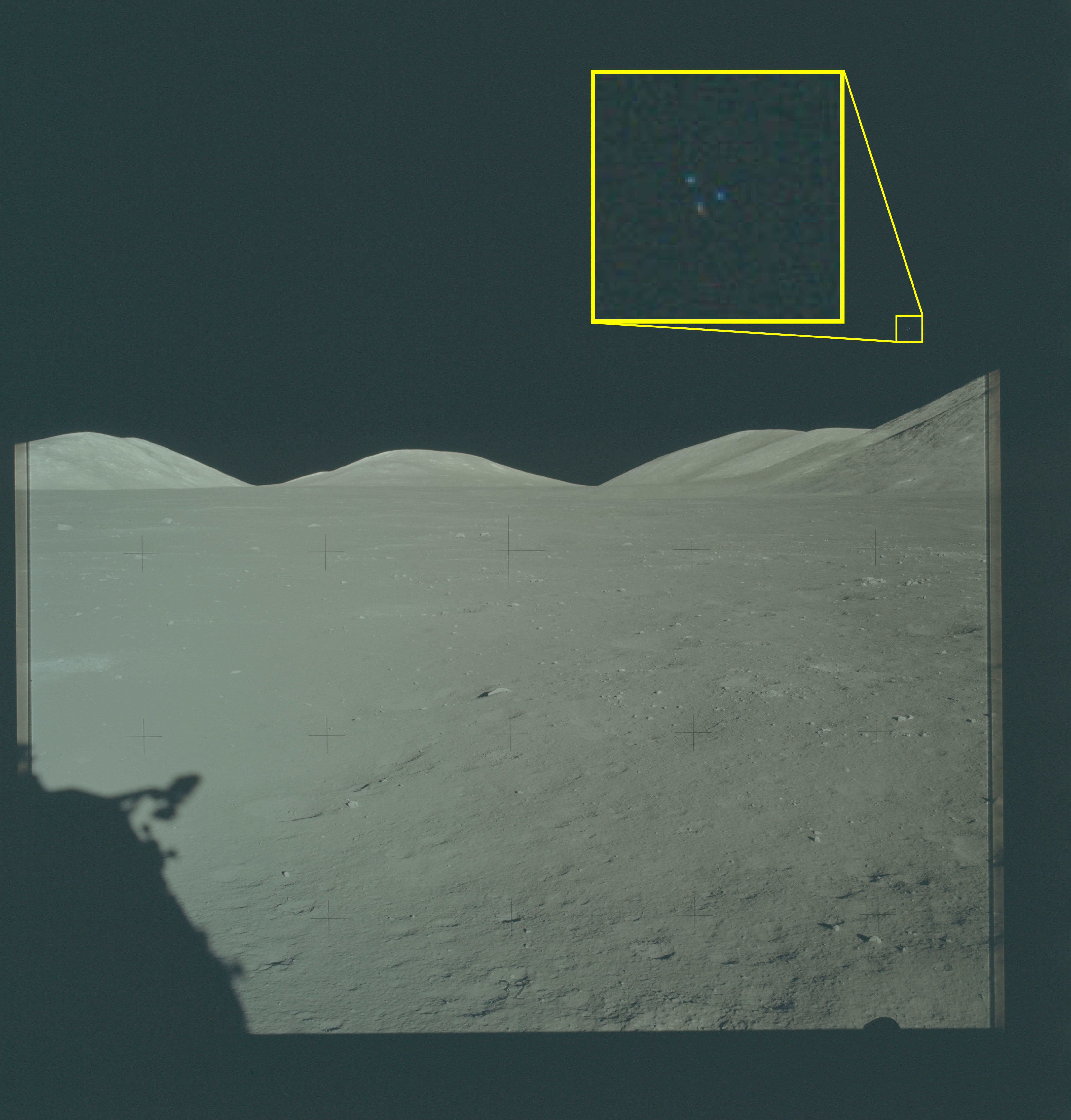
The investigation into these sightings was conducted through the formal post-flight debriefing process, a standard procedure for all Apollo missions. NASA engineers and flight controllers scrutinized the transcripts to determine if the anomalies posed any risk to the mission or if they could be explained by spacecraft malfunctions. The debriefing records, now part of the Pentagon's 2026 UAP release, show that the crew was pressed for details on how they identified these objects. The investigation involved comparing the sightings against the known flight path and the configuration of the spacecraft. In the case of the triangular formation observed during the later Apollo 17 mission, the investigation was even more rigorous, involving photographic analysis. The Pentagon’s 2026 release included a NASA photograph from 1972 showing three dots in a triangular formation above the lunar surface. Preliminary analysis by government agencies suggested that this formation could represent a "physical object," though the official caption noted that there was "no consensus about the nature of the anomaly," leaving the investigation open-ended and shrouded in uncertainty.
The official record
The official record of these events is contained within the Apollo 11 Technical Crew Debriefing (1969) and the Apollo 17 Technical Crew Debriefing (1973). For years, these documents were classified, with the Apollo 11 debriefing specifically marked as "Confidential" and subject to downgrading at three-year intervals. The records highlight the crew's uncertainty, with Aldrin explicitly stating, "we really don't have a conclusion as to what it might have been." The documents were eventually declassified as part of a broader historical sweep by the Pentagon, which included UAP compendiums from the 1940s to the present day. The records are notable not just for what they confirm, but for what they leave unexplained. The 1973 Apollo 17 debriefing, for instance, describes a light flash on the lunar surface that remains without a confirmed scientific explanation to this day. The official stance of the government has shifted from total silence to a more transparent, albeit cautious, acknowledgment that these phenomena were documented systematically, if sporadically, over the course of nearly 80 years of space exploration.
The arguments
Skeptical explanations for these sightings generally focus on the harsh environment of space and the limitations of human perception. Regarding the light flashes, NASA medical teams and the astronauts themselves speculated that they were caused by cosmic rays or neutrons interacting with the retina, a phenomenon later confirmed in other missions. The "sizeable object" seen during the translunar coast has been argued by some to be a piece of the spacecraft, such as the S-IVB stage or a fragment of the high-gain antenna, which may have been reflecting sunlight in a way that created an optical illusion. However, these explanations do not satisfy all observers. The crew's own uncertainty, as recorded in the debriefing, suggests that the visual data did not perfectly align with these mundane theories. The "fairly bright light source" seen in lunar orbit was later compared by Aldrin to sunlight reflecting off a body of water, yet the initial classification of the event as a potential laser indicates that the crew felt the light possessed characteristics that were not easily dismissed as simple reflections or optical artifacts.
Where the case stands today
Today, the Apollo-era UAP files serve as a cornerstone of the modern discourse on unexplained aerial and spatial phenomena. The release of these documents has reignited public and scientific interest in what the astronauts actually encountered during the dawn of the space age. NASA Administrator Jared Isaacman has publicly acknowledged the importance of these findings, stating that the agency is planning future missions in part due to the "possible existence of extraterrestrial alien lifeforms." His comments to NBC's Meet the Press, where he noted that the odds of finding evidence that we are not alone are "pretty high," underscore the shift in institutional attitude. The case remains significant because it bridges the gap between historical military documentation and contemporary scientific inquiry. As we look toward returning to the Moon, the unresolved anomalies of 1969 and 1972 serve as a reminder that the lunar environment may hold mysteries that our current understanding of physics and space travel has yet to fully resolve. The files are no longer hidden, but the answers they contain remain as elusive as the objects themselves.
— CHAIN OF CUSTODY: SOURCES & FURTHER READING
— FIELD REPORTS (0)
Sign in to post a field report.
No field reports yet. Be the first to contribute.
DISCLAIMER: Every story on this site is based on documented real-world reports or official records. We do not publish fiction. All sources are cited above.