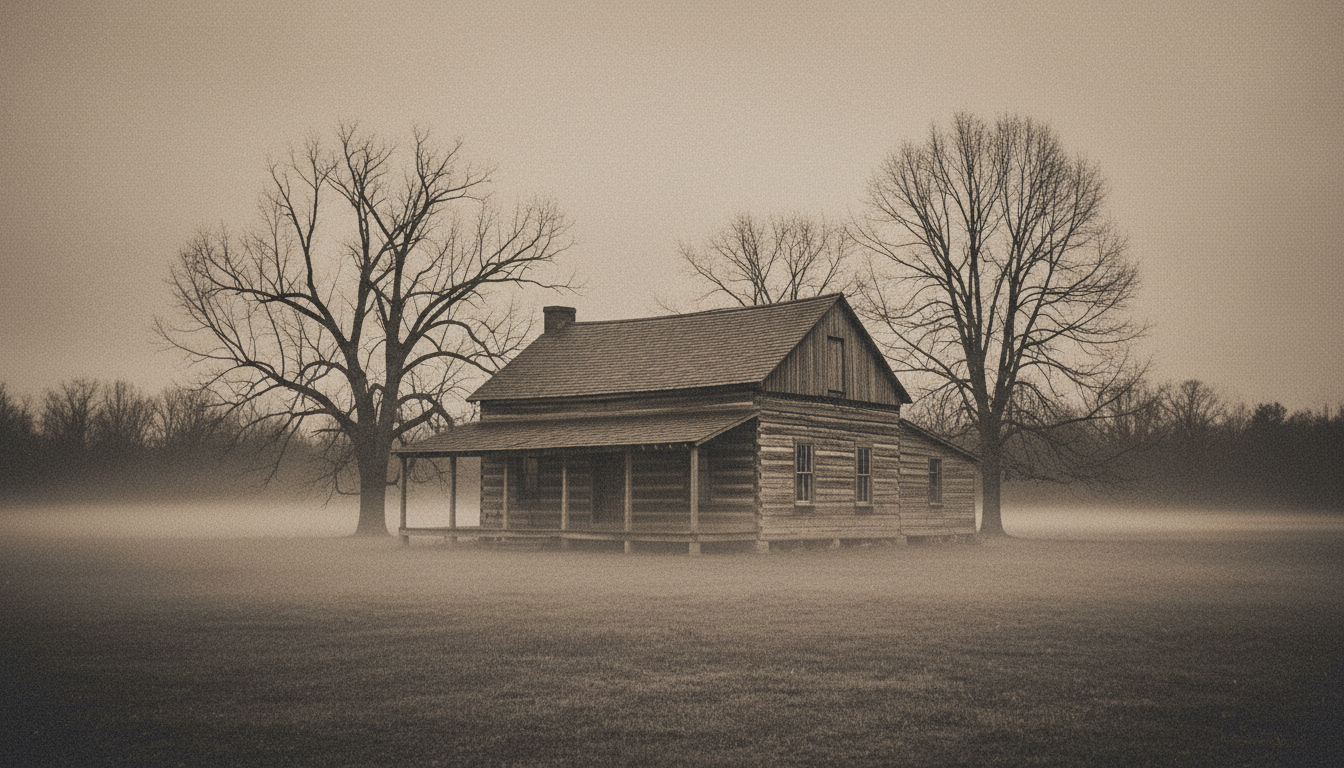
The 1977 Point Pleasant Mothman Sightings
— EXECUTIVE SUMMARY
Between 1966 and 1967, the small town of Point Pleasant, West Virginia, became the epicenter of a series of bizarre sightings involving a winged, red-eyed humanoid dubbed the 'Mothman.' The phenomenon concluded abruptly with the tragic collapse of the Silver Bridge, leaving behind a legacy that blends genuine historical tragedy with enduring American folklore.
The moment it began
The atmosphere in Point Pleasant, West Virginia, during the autumn of 1966 was heavy with the quietude of a post-industrial landscape. On November 12, 1966, five men were engaged in the somber task of digging a grave at a cemetery near Clendenin, just outside the main town, when the air seemed to shift. According to reports, they observed a large, brown, human-shaped form lift off from the nearby trees and glide over them. It was a fleeting, unsettling encounter that set the stage for what would become a thirteen-month period of high strangeness. However, the true catalyst for the town’s collective anxiety occurred on the night of November 15, 1966. Two young couples, Roger and Linda Scarberry and Steve and Mary Mallette, were driving through the desolate 'TNT area'—a sprawling, overgrown site of abandoned World War II munitions bunkers. The night was dark, and the headlights of their vehicle cut through the gloom, illuminating the skeletal remains of the old power plant. It was here, in the heart of the rural Ohio River Valley, that the mundane reality of a late-night drive collided with the inexplicable, marking the birth of a legend that would soon captivate the nation.
What they saw
As the couples navigated the winding roads near the abandoned National Guard Armory, their headlights caught something standing near a generator plant. It was a figure, roughly six to seven feet tall, possessing a humanoid shape but appearing distinctly 'wrong.' The witnesses described a creature with large, folded wings and glowing, hypnotic red eyes that seemed to pierce the darkness. The encounter was immediate and terrifying. As the couples attempted to flee the area in their car, the creature reportedly took flight, pursuing them at high speeds. Witnesses claimed the entity did not flap its wings in the traditional sense but instead glided with an unnatural, silent grace. It followed their vehicle toward the Point Pleasant city limits, emitting a screeching, mechanical sound that left the occupants in a state of profound distress. This sequence of events—the initial sighting, the pursuit, and the auditory phenomena—established the core characteristics of the entity that would soon be christened the 'Mothman' by local media. The creature’s ability to keep pace with a moving vehicle and its unsettling, unblinking gaze became the defining features of the reports that followed in the subsequent weeks.
The witnesses
Following the initial encounter, the witnesses were thrust into a spotlight they had not sought. Roger and Linda Scarberry, along with Steve and Mary Mallette, were the first to provide formal statements to local law enforcement. Their accounts were consistent, describing a creature that defied conventional biological classification. As news of their experience spread, other residents began to come forward, emboldened by the fact that they were not alone in their observations. Journalists like Mary Hyre of the 'Athens Messenger' played a crucial role in documenting these testimonies. Hyre, who maintained a close correspondence with paranormal researcher John Keel, recorded numerous accounts from citizens who claimed to have seen the creature in fields, near homes, and around industrial sites. These witnesses were not merely thrill-seekers; they were local workers, firemen, and families who found themselves caught in a cycle of fear. Their documented words, often characterized by a sense of genuine bewilderment, painted a picture of a community under siege by an anomaly that refused to be ignored, with many individuals expressing a deep-seated reluctance to speak out for fear of ridicule.
The investigation
As the reports multiplied, Point Pleasant became a magnet for investigators of all stripes. John Keel, a New York-based writer and ufologist, arrived in the area to conduct his own inquiries. Keel’s approach was unconventional; he did not merely look for the creature but sought to map the 'high strangeness' of the region, noting a correlation between the Mothman sightings and reports of UFOs, as well as the presence of mysterious figures often referred to as 'Men in Black.' Keel’s work, later synthesized in his 1975 book 'The Mothman Prophecies,' served to elevate the local sightings into a broader narrative of paranormal activity. While Keel collected hundreds of accounts, other investigators, including local authorities and amateur researchers, attempted to find physical evidence. They scoured the TNT area, looking for tracks, biological samples, or photographic proof. Despite the intensity of the search, no definitive physical evidence was ever recovered. The investigation remained largely anecdotal, relying on the consistency of witness reports rather than empirical data, which only served to deepen the mystery surrounding the entity’s true nature and origin.
The official record
The official record of the period is a stark contrast to the folklore that emerged from it. While local newspapers like the 'Point Pleasant Register' provided extensive coverage, the state and federal archives contain little regarding the creature itself. The most significant official documentation from this era concerns the tragic collapse of the Silver Bridge on December 15, 1967. The National Transportation Safety Board (NTSB) investigation into the disaster concluded that the collapse was caused by the failure of a single eyebar—specifically eyebar #330—in the suspension chain, a result of stress corrosion and fatigue. The bridge, which carried U.S. Route 35 across the Ohio River, fell during rush hour, resulting in 46 fatalities. While the Mothman sightings ceased abruptly on the night of the collapse, the official engineering reports make no mention of any anomalous phenomena. The connection between the creature and the bridge is entirely a product of post-hoc narrative construction, where the community’s collective trauma sought meaning in the preceding months of unexplained sightings, effectively braiding the cryptid legend into the history of the bridge’s structural failure.
The arguments
Skeptics have long argued that the Mothman phenomenon is a classic case of misidentification and mass hysteria. Joe Nickell, an investigator with the Committee for Skeptical Inquiry, has suggested that the original sightings were likely the result of a large nocturnal bird, such as a sandhill crane or a barn owl, whose reflective eyes and unusual silhouette could easily be misinterpreted by frightened witnesses in the dark. This explanation posits that the 'red eyes' were simply the result of light reflecting off the tapetum lucidum of a bird’s eyes, and the 'wings' were the creature’s natural anatomy. Furthermore, the social contagion of the sightings—where one report encourages others to interpret mundane events as supernatural—is a well-documented psychological phenomenon. However, proponents of the cryptid theory argue that no conventional animal accounts for the specific combination of size, humanoid shape, and the reported behavior of the entity. They maintain that the sheer volume of reports, spanning over a year, suggests that something more complex than a simple misidentification was occurring, even if the nature of that 'something' remains entirely elusive to modern science.
Where the case stands today
Today, the Mothman of Point Pleasant occupies a unique space in American culture. The town has embraced its legacy, establishing the Mothman Museum and erecting a stainless-steel statue in Gunn Park, which serves as a focal point for paranormal tourism. The case remains a subject of ongoing interest for cryptozoologists and folklorists alike, serving as a primary example of how a local legend can evolve into a global phenomenon. While the engineering cause of the Silver Bridge collapse is well-documented and undisputed, the cultural narrative persists, linking the tragedy to the creature in a way that provides a sense of closure to the mystery. The Mothman is no longer just a creature of the woods; it is a symbol of the intersection between human fear, historical tragedy, and the enduring need to find meaning in the unknown. Whether one views the Mothman as a biological anomaly, a psychological projection, or a piece of modern mythology, its presence in the annals of Point Pleasant remains a testament to the power of storytelling and the persistent allure of the unexplained.
— CHAIN OF CUSTODY: SOURCES & FURTHER READING
— FIELD REPORTS (0)
Sign in to post a field report.
No field reports yet. Be the first to contribute.
DISCLAIMER: Every story on this site is based on documented real-world reports or official records. We do not publish fiction. All sources are cited above.