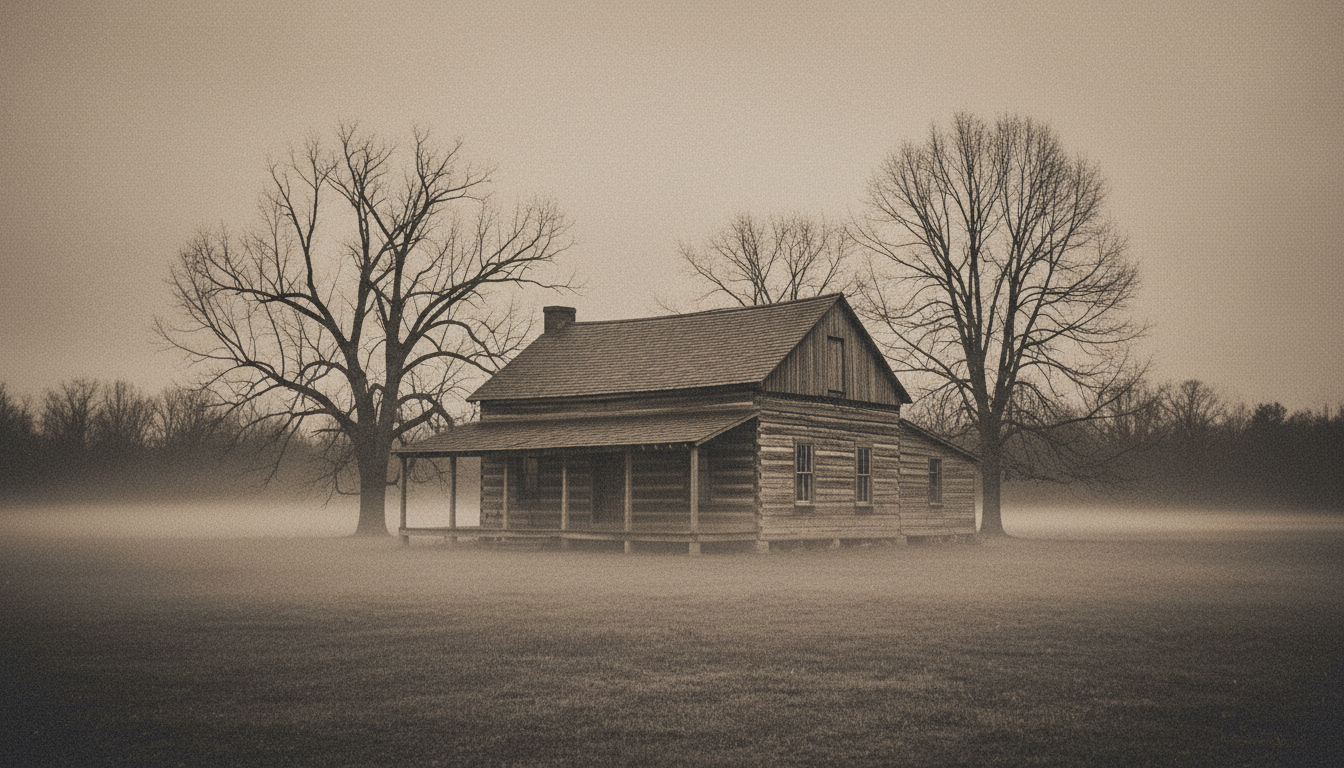
The Flatwoods Monster Encounter of 1952
— EXECUTIVE SUMMARY
On September 12, 1952, a group of residents in Flatwoods, West Virginia, reported a terrifying encounter with a towering, glowing entity following a UFO sighting. While later investigations attributed the event to a meteor and a barn owl, the incident remains a foundational and debated pillar of American ufology.
The moment it began
It was approximately 7:15 P.M. on September 12, 1952, in the quiet, timbered hills of Braxton County, West Virginia. The atmosphere in the small village of Flatwoods was typical for a late summer evening until the sky suddenly ignited. A group of local youths, including brothers Edward and Fred May and their friend Tommy Hyer, were playing football on the school playground when they witnessed a brilliant, fiery object streak across the darkening horizon. The object appeared to descend rapidly, seemingly crashing or landing on a nearby hilltop belonging to the Bailey Fisher farm. The suddenness of the event, combined with the unusual trajectory of the light, immediately galvanized the boys. Driven by a mixture of youthful curiosity and genuine alarm, they rushed to the home of Kathleen May, a local beautician and mother to the May brothers. Mrs. May, sensing the urgency in the children’s report, provided a flashlight and agreed to accompany them to the site. They were joined by other locals, including Neil Nunley, Gene Lemon, and a dog named Rickie, as they began the trek up the hillside into the encroaching shadows of the Appalachian night, unaware that they were walking toward a moment that would define local folklore for decades to come.
What they saw
As the group ascended the hill, the environment began to shift in ways that defied their expectations. Witnesses reported a pungent, metallic mist hanging in the air, which some later claimed caused physical symptoms such as nausea. Upon reaching the crest of the hill, the group encountered a pulsing, glowing red light that seemed to emanate from a source beyond the trees. As they approached, the light illuminated a bizarre, towering figure standing near an oak tree. The entity was described as approximately 10 feet tall, possessing a man-like shape but with a distinct, spade-shaped hood surrounding a glowing, round red face. Its body was reported to be green, and witnesses noted what appeared to be drape-like folds or clothing. The creature did not remain stationary; it emitted a high-pitched, aggressive hissing sound and began to glide or float toward the group. The sudden movement and the sheer, unnatural scale of the entity triggered an immediate, primal panic. Gene Lemon, who was leading the group with the flashlight, reportedly screamed and dropped the light in terror. The group turned and fled down the hill, their fear compounded by the sight of their dog, Rickie, running with his tail tucked between his legs, signaling a deep, instinctual dread that mirrored their own.
The witnesses
The primary witnesses to the Flatwoods encounter were a diverse group of local residents whose testimonies were captured shortly after the event. Kathleen May, the mother who led the expedition, remained a central figure in the narrative, often recounting the details of the "monster" with a consistency that impressed early investigators. Her sons, Edward and Fred May, along with their friends Tommy Hyer, Neil Nunley, and Gene Lemon, provided the core eyewitness accounts. Gene Lemon, a member of the National Guard, was perhaps the most scrutinized due to his military background, yet his reaction—dropping the flashlight and fleeing in terror—was cited by local newspaper publisher A. Lee Stewart Jr. as evidence of the group's genuine fear. Stewart, who marched up the hill with a shotgun shortly after the incident, famously remarked that he had never seen people so genuinely frightened. Despite the skepticism that would later emerge, these individuals maintained that they had seen something that defied conventional explanation. Their accounts were not merely stories told for attention; they were the reactions of people who had been thrust into a situation they could not comprehend, and their documented distress served as the foundation for the legend that would soon sweep across the nation.
The investigation
In the immediate aftermath of the sighting, the investigation was handled by a mix of local authorities and amateur researchers. A. Lee Stewart Jr., the publisher of the Braxton Democrat, visited the site the following day and discovered physical evidence that added a layer of mystery to the claims. He reported finding "skid marks" in the roadside field and an "odd, gummy deposit" that he believed were linked to the landed object. These findings were corroborated by other locals who scoured the area. Meanwhile, the local sheriff and a deputy, who had been busy investigating reports of a separate airplane crash, arrived to search the site but reported that they saw, heard, and smelled nothing. Later, the paranormal writer and researcher Gray Barker arrived on September 19, 1952, to conduct tape-recorded interviews with the witnesses. Barker’s work, later published in Fate magazine as "The Monster and the Saucer," helped solidify the details of the encounter for a national audience. Additionally, reports from the time indicate that National Guardsmen were seen conducting their own investigation of the mountain scene, though the extent of their findings remains largely undocumented in public records.
The official record
Despite the widespread public interest and the intensity of the local reports, the official government response to the Flatwoods incident was notably sparse. Contrary to popular belief, there is no evidence that the U.S. Air Force’s Project Blue Book ever mounted a formal, on-site field investigation of the Flatwoods site. While Project Blue Book was tasked with investigating UFO claims across the United States during the 1950s, the Flatwoods case appears to have been handled primarily through local channels and later retrospective analysis. The official record, as it exists in the archives, is largely devoid of a definitive "verdict" from the military at the time of the event. Much of what is cited as the "official" explanation—the combination of a meteor, an aircraft beacon, and a barn owl—is a synthesis developed by later investigators rather than a contemporary finding by the Air Force. The lack of a formal, classified report has left the case in a state of perpetual ambiguity, with the government neither confirming the existence of an extraterrestrial entity nor providing a comprehensive, evidence-based debunking that satisfied the witnesses who were there that night.
The arguments
Over the decades, the Flatwoods incident has been subjected to rigorous skeptical analysis, most notably by investigator Joe Nickell in his 2000 article for the Skeptical Inquirer. The skeptical argument posits that the "bright object" seen in the sky was a meteor, a claim supported by reports from other states, including Maryland and Pennsylvania, where a fireball was logged by the American Meteor Society. The pulsing red light on the ground, according to this theory, was likely one of several aircraft beacons visible from the hilltop, which, when viewed through the lens of fear and darkness, could be misinterpreted. The "monster" itself is often attributed to a startled barn owl (Tyto alba) perched on a tree branch, with its wings spread and its silhouette distorted by the shadows and the witnesses' heightened emotional state. While these explanations are logically sound and account for the individual elements of the sighting, critics argue that they fail to explain the collective, intense fear of the witnesses, the physical symptoms of nausea, and the specific, consistent descriptions of the entity's movement and appearance. The skeptical synthesis is a compelling reconstruction, but it remains a theory that relies on the assumption of mass misperception rather than direct evidence.
Where the case stands today
Today, the Flatwoods Monster remains a fixture in American UFO lore and a cornerstone of West Virginia's cultural identity. The village of Flatwoods has embraced its legacy, with a dedicated museum, festivals, and various pop-culture tributes that keep the story alive for new generations. The case is frequently cited in academic and media discussions as a prime example of how societal anxiety during the Cold War era influenced the interpretation of unidentified phenomena. While the "meteor, beacon, and owl" explanation is widely accepted in scientific circles, the case has never been "closed" in the eyes of the public or the remaining witnesses. It serves as a reminder of the limitations of retrospective investigation; when the physical evidence is gone and the witnesses have passed, we are left with a narrative that is as much about the human experience of the unknown as it is about the event itself. The Flatwoods Monster persists not because it has been proven, but because it represents a moment where the mundane world of a small Appalachian town collided with the inexplicable, leaving behind a mystery that continues to invite curiosity, debate, and wonder.
— CHAIN OF CUSTODY: SOURCES & FURTHER READING
— FIELD REPORTS (0)
Sign in to post a field report.
No field reports yet. Be the first to contribute.
DISCLAIMER: Every story on this site is based on documented real-world reports or official records. We do not publish fiction. All sources are cited above.