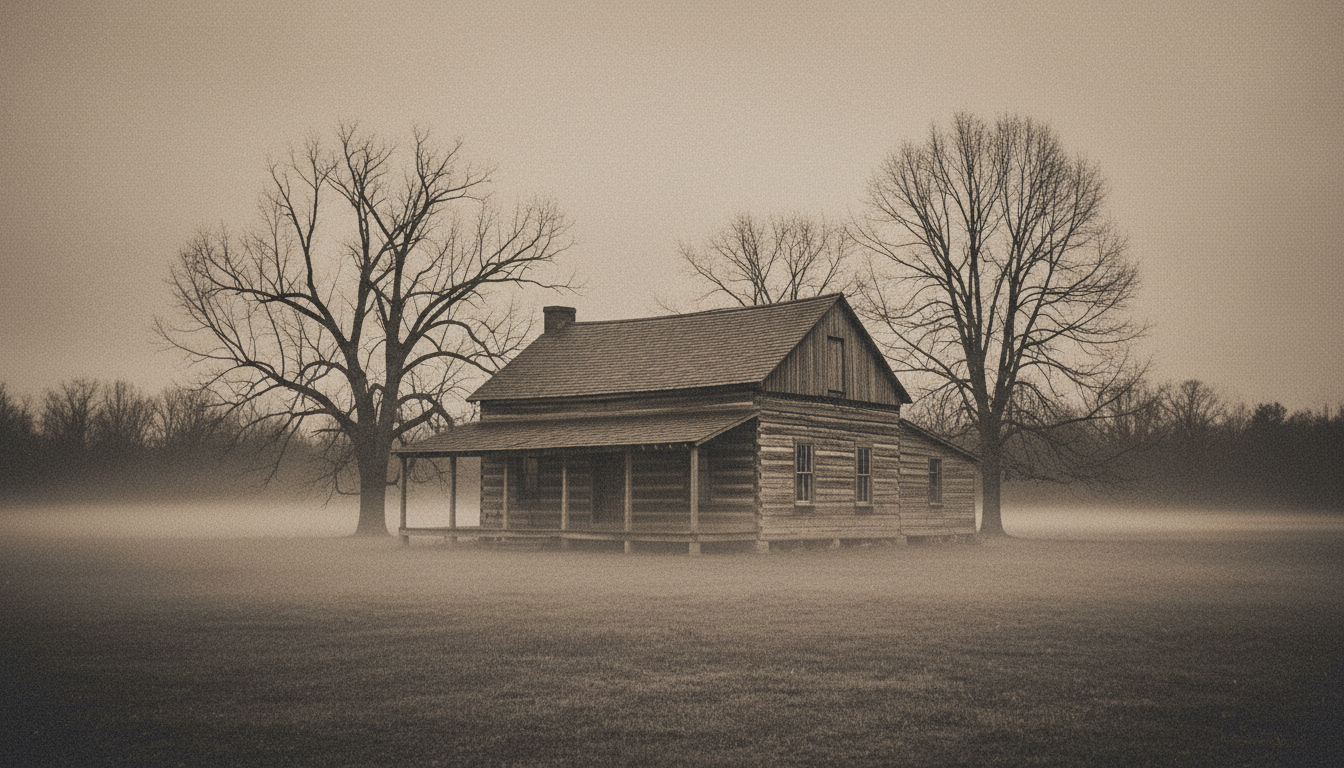
The 1850s Ghostly Apparition of the Old Man in Arlington, Vermont
— EXECUTIVE SUMMARY
The Bell Witch haunting of 1817–1821 remains one of America's most enduring paranormal mysteries, involving a malevolent entity that tormented the John Bell family in Adams, Tennessee. The spirit, known as 'Kate,' allegedly caused physical harm, spoke with human intelligence, and ultimately contributed to the death of the family patriarch.
The moment it began
In the autumn of 1817, the quiet, agrarian life of John Bell and his family in Robertson County, Tennessee, was irrevocably shattered. John Bell, a prosperous farmer who had migrated from North Carolina in 1804, was walking through his cornfield near the Red River when he encountered a sight that defied natural explanation. According to accounts, he spotted a strange creature that appeared to be a dog with the head of a rabbit. Startled, Bell fired his weapon at the apparition, but the creature vanished instantly. This singular, unsettling event served as the catalyst for a series of disturbances that would soon consume the household. The atmosphere in the Bell home, previously defined by the rhythms of rural labor and family life, shifted into one of pervasive dread. As the sun set over the Tennessee frontier, the family began to experience inexplicable phenomena that would persist for years, marking the beginning of what is now widely regarded as one of the most significant poltergeist cases in American history.
What they saw
Following the initial sighting in the cornfield, the disturbances escalated with terrifying speed. The Bell household became the epicenter of a barrage of supernatural activity. Initially, the manifestations were subtle: inexplicable knocking sounds against the walls, the rhythmic scratching on bed ticks, and the sudden, violent pulling of bedclothes from sleeping family members. As the weeks progressed, the entity—which would later identify itself as 'Kate'—began to manifest in more aggressive forms. Witnesses reported the spirit appearing as a bear, a rabbit, and a black dog. The entity possessed the ability to speak, often quoting scripture, singing hymns, and engaging in profane, vulgar taunts that left the family and their visitors in a state of shock. The physical environment was not spared; furniture was overturned, and the house itself reportedly shook as if buffeted by a violent storm. The entity exhibited a particular, targeted malice toward John Bell and his daughter, Betsy, frequently pinching, scratching, and beating them, while curiously maintaining a facade of kindness toward John’s wife, Lucy.
The witnesses
The haunting was not a private affair; it drew the attention of the entire community and beyond. Neighbors, including James Johnston and his wife, spent nights in the Bell home, documenting their own encounters with the disembodied voice and moving objects. The entity was known to narrate the private intimacies of local residents, disclosing secrets from miles away with unsettling accuracy. One enslaved worker on the Bell property, known as Dean, reported being stalked by a large black dog during his evening travels to visit his wife. The sheer volume of witnesses—people traveling from at least half a dozen states to hear the spirit—transformed the Bell farm into a site of intense public fascination. These accounts, later compiled in works like Martin V. Ingram’s 1894 'Authenticated History of the Bell Witch' and Charles Bailey Bell’s 'A Mysterious Spirit,' provide a tapestry of testimony from individuals who claimed to have heard the voice and witnessed the physical manifestations firsthand, cementing the event in the regional consciousness.
The investigation
As the notoriety of the 'Bell Witch' spread, the case attracted the attention of prominent figures of the era. Legend holds that even Andrew Jackson, a neighbor and future President, traveled to the Bell farm to investigate the phenomenon. While no personal writings from Jackson confirm this visit, the story persists as a cornerstone of the local lore. Investigators, ranging from curious locals to self-styled spiritualists, attempted to document the entity's behavior. They measured the intensity of the sounds and observed the physical attacks on the family members. In the pre-digital age, visitors often struggled to capture the phenomenon, with many reporting the notorious difficulty of taking photographs around the site. The investigation was less a scientific inquiry and more a social phenomenon, as the 'detective business'—a term later criticized by skeptics as anachronistic for the 1817 period—became a central part of the narrative. These early efforts to 'solve' the haunting laid the groundwork for what would eventually become modern ghost-hunting culture.
The official record
There is no singular 'official' government file on the Bell Witch, as the events predated modern forensic documentation. However, the historical record is preserved through local archives, land deeds, and the aforementioned 1894 publication by Martin V. Ingram, which serves as the primary source for the legend. The records indicate that John Bell was excommunicated from his church in 1818, officially due to a dispute over a slave sale, though many speculate the haunting played a role in his social isolation. The most tragic entry in the record is the death of John Bell in December 1820. His decline was marked by painful physical symptoms, leading many to believe he had been poisoned by the entity. Modern researchers, such as those investigating the case for the Tennesseean, have explored scientific explanations, including the possibility of arsenic poisoning, though no definitive cause of death was ever officially recorded. The spirit continued its activity through the spring of 1821 before announcing its departure, promising to return in seven years.
The arguments
Skeptics have long argued that the Bell Witch haunting was a fabrication, a 'fakelore' constructed to explain away family tensions or to serve as a ruse. One prominent theory suggests the entire ordeal was a calculated effort to break up the engagement between Betsy Bell and her fiancé, Joshua Gardner, whom the entity vehemently opposed. Critics point to the lack of contemporary, non-anecdotal evidence and the fact that the most detailed accounts were written decades after the events occurred. Some researchers, such as those cited in the 'Skeptical Inquirer,' note that the term 'detective' used in early accounts is anachronistic, suggesting that the narrative was embellished over time. Others argue that the 'witch' was a manifestation of the family's own psychological distress or a cover for domestic abuse. Despite these arguments, the persistence of the story and the consistency of the witness reports across different sources make it difficult for many to dismiss the case entirely as a mere hoax.
Where the case stands today
Today, the Bell Witch remains a fixture of American folklore and a subject of ongoing intrigue. The site of the original Bell home in Adams, Tennessee, is marked by a state historical marker, and the nearby Bell Witch Cave was added to the National Historical Registry in 2008. While the original house is long gone, the cave serves as a focal point for those hoping to experience a remnant of the haunting. The story has been adapted into theatrical productions, books, and television programs, ensuring its place in the cultural zeitgeist. It matters because it serves as a mirror to 19th-century American society, reflecting the era's deep-seated beliefs in the supernatural and the frontier's struggle to reconcile the unknown with the rational. Whether viewed as a genuine paranormal event, a psychological breakdown, or a masterfully crafted legend, the Bell Witch continues to challenge our understanding of history and the persistence of the unexplained.
— CHAIN OF CUSTODY: SOURCES & FURTHER READING
— FIELD REPORTS (0)
Sign in to post a field report.
No field reports yet. Be the first to contribute.
DISCLAIMER: Every story on this site is based on documented real-world reports or official records. We do not publish fiction. All sources are cited above.