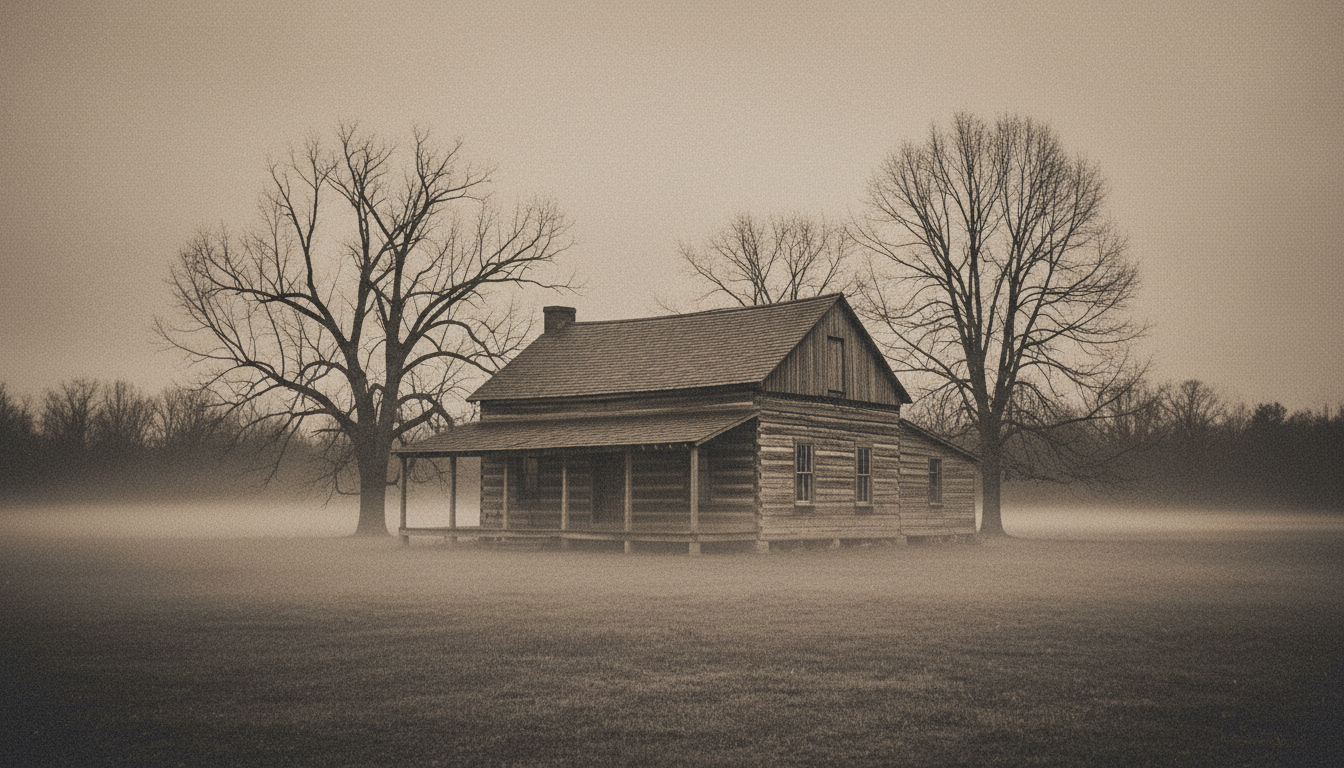
The Davenport Poltergeist: A 19th Century Haunting
— EXECUTIVE SUMMARY
The 1857 Davenport poltergeist case involving the McCausland family on Brady Street remains a landmark event in 19th-century American paranormal history. Despite intense media scrutiny and scientific investigation, the phenomena—ranging from inexplicable noises to moving furniture—left the public and experts divided on its authenticity.
The moment it began
The year was 1857, a time when the American frontier was rapidly expanding and the spiritualist movement was beginning to take a firm hold on the cultural imagination. In the bustling river city of Davenport, Iowa, the McCausland family resided in a home situated on Brady Street. It was a typical mid-19th-century dwelling, yet it would soon become the epicenter of a series of events that defied the rational explanations of the era. The onset of the disturbance was not marked by a singular, dramatic event, but rather by a creeping sense of unease that permeated the household. As the family went about their daily routines, the atmosphere within the home began to shift. It started with subtle, auditory anomalies—faint knocking sounds that seemed to emanate from the very walls of the structure, followed by rhythmic rattling that defied the structural integrity of the house. The family, initially dismissive, soon found that these sounds were not merely the settling of timber or the wind against the siding. They were deliberate, persistent, and increasingly aggressive. As the sun dipped below the horizon and the family gathered in the dim light of oil lamps, the house seemed to come alive with a presence that felt both intrusive and profoundly alien to their domestic peace.
What they saw
The phenomena quickly escalated from auditory disturbances to physical manifestations that left the McCausland family in a state of genuine terror. Witnesses reported that objects within the home began to move with a volition that suggested an unseen hand. Furniture, heavy and cumbersome, was observed shifting across rooms, sliding across floorboards as if pushed by an invisible force. Dishes, once neatly arranged in cupboards, were suddenly hurled through the air, shattering against walls with violent force. The family, trapped in what they perceived as a siege by a malevolent entity, watched in disbelief as their domestic environment was systematically dismantled. These events were not isolated; they occurred with a frequency and intensity that made normal life impossible. The sequence of these occurrences—the knocking, the rattling, the movement of furniture, and the projectile motion of household items—created a pattern of activity that would later be classified by researchers as classic poltergeist behavior. The family felt as though they were being targeted, their home transformed into a theater of the impossible, where the laws of physics seemed to be suspended at the whim of an unseen, disruptive force that refused to be ignored.
The witnesses
As word of the disturbances spread beyond the walls of the Brady Street home, the McCausland family found themselves at the center of a local and eventually national spectacle. Neighbors, initially skeptical, began to flock to the residence, eager to catch a glimpse of the inexplicable. These witnesses, ranging from curious townspeople to prominent local figures, provided accounts that corroborated the family's claims. Their testimonies were varied, yet they shared a common thread of bewilderment. Some described the sounds as being so distinct that they could be heard from the street, while others claimed to have witnessed the movement of objects firsthand. The sheer volume of people converging on the property turned the McCausland home into a public curiosity. The family, overwhelmed by the attention, found their private trauma transformed into a public narrative. Their documented words, captured in the journals and letters of the time, reflect a profound sense of helplessness and a desperate search for answers. They were not merely observers of the haunting; they were its primary victims, forced to navigate a reality where their own home had become a place of fear and uncertainty, witnessed by a community that was both fascinated and deeply unsettled by what they saw.
The investigation
The Davenport case did not escape the notice of the scientific and intellectual communities of the 19th century. Investigators, driven by a desire to either debunk the claims or to understand the underlying mechanisms of the phenomena, descended upon the McCausland home. These individuals, including self-proclaimed experts in the burgeoning field of spiritualism and staunch skeptics from the scientific establishment, sought to apply the rigorous methods of the day to the situation. They measured the dimensions of the rooms, examined the structural integrity of the house, and attempted to replicate the sounds and movements through naturalistic means. Some utilized the limited technology available to them, documenting the timing and frequency of the events. However, the investigation was fraught with difficulty. The presence of so many observers often complicated the environment, making it nearly impossible to isolate variables or ensure that the phenomena were not being influenced by the very people attempting to study them. Despite their efforts, the investigators remained divided, with many unable to reconcile the physical evidence with their existing understanding of the natural world, leaving the case in a state of perpetual ambiguity.
The official record
The official record of the Davenport poltergeist is a testament to the limitations of 19th-century documentation. While newspapers such as the New York Times and the Chicago Tribune provided extensive coverage, the actual investigative files—if they ever existed in a formal, centralized capacity—have largely been lost to time or were never compiled in a way that would satisfy modern standards of evidence. What remains are the fragmented accounts, the sensationalized headlines, and the anecdotal evidence that has been passed down through generations of paranormal researchers. The case was never officially resolved, and no definitive explanation was ever provided by the authorities of the time. Much of the information regarding the specific nature of the haunting was left to the interpretation of those who were present, and the lack of a centralized, objective record has allowed the story to evolve into a legend. The absence of a final, authoritative report means that the Davenport case remains an open question, a historical anomaly that continues to challenge our understanding of the boundaries between the known and the unknown, and the ways in which we document the inexplicable.
The arguments
The debate surrounding the Davenport poltergeist has been as persistent as the haunting itself. Skeptics have long argued that the events were the result of a hoax, pointing to the potential for human intervention, the psychological stress of the family, or the desire for attention as primary drivers of the activity. They suggest that the movement of objects and the strange noises could have been easily faked by members of the household or by visitors seeking to perpetuate the mystery. Conversely, proponents of the paranormal argue that the sheer volume of witnesses and the consistency of the reports across different times and observers make a simple hoax unlikely. They point to the fact that the phenomena occurred in the presence of skeptics and believers alike, and that the intensity of the events was beyond what could be reasonably expected from a prank. The argument often centers on the nature of poltergeist activity itself—whether it is a manifestation of external spirits or a projection of human psychological energy. These competing viewpoints have never been reconciled, and the Davenport case remains a focal point for those who argue that there are phenomena in our world that defy conventional scientific explanation.
Where the case stands today
Today, the Davenport poltergeist is remembered as a foundational case in the study of American hauntings. It continues to be referenced in paranormal literature, serving as a case study for researchers interested in the history of spiritualism and the cultural attitudes toward the supernatural in the 19th century. The legacy of the case lies not in a definitive answer, but in the questions it continues to raise about the nature of belief, the reliability of witness testimony, and the ways in which we interpret the unexplained. It serves as a reminder that even in an age of scientific advancement, there are experiences that remain outside our grasp. The Davenport case underscores the importance of historical context in understanding how hauntings were perceived and documented, and it continues to influence modern paranormal research by highlighting the potential for misinterpretation and the role of societal belief systems in shaping our perceptions. As long as people continue to seek answers to the mysteries of the unknown, the story of the McCausland family and their ordeal on Brady Street will remain a vital part of the American paranormal narrative, a haunting that refuses to be laid to rest.
— CHAIN OF CUSTODY: SOURCES & FURTHER READING
— FIELD REPORTS (0)
Sign in to post a field report.
No field reports yet. Be the first to contribute.
DISCLAIMER: Every story on this site is based on documented real-world reports or official records. We do not publish fiction. All sources are cited above.