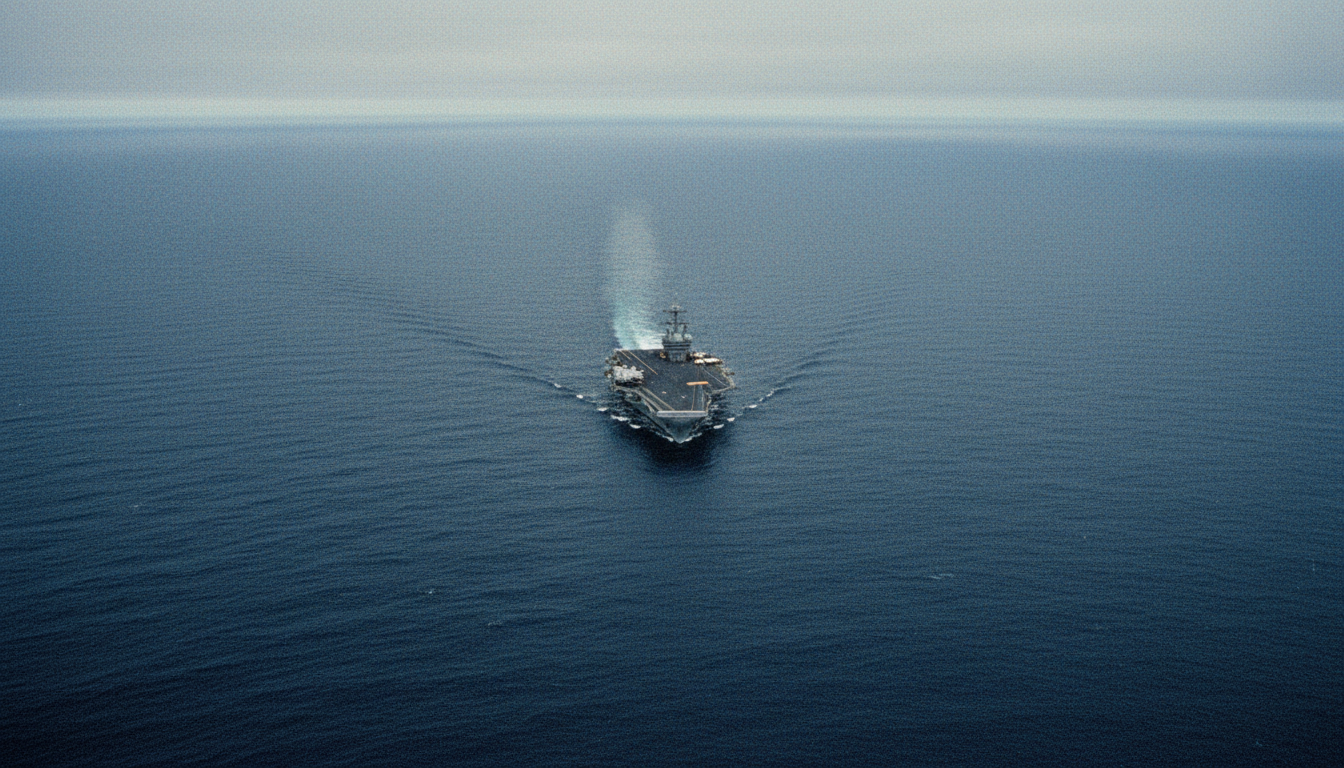
The 1952 Operation Mainbrace UAP Encounters: A NATO Naval Mystery
— EXECUTIVE SUMMARY
Operation Mainbrace in 1952 stands as a landmark event in UAP history, where NATO naval forces encountered unidentified aerial phenomena during a massive Cold War exercise. These sightings, involving multiple nations and military branches, forced official recognition of the UAP mystery within the highest levels of Western defense command.
The moment it began
In September 1952, the North Sea and the waters surrounding Scandinavia became the stage for Operation Mainbrace, the most ambitious naval exercise ever conducted by the North Atlantic Treaty Organization. With the Cold War chill deepening, the alliance mobilized 200 ships, 1,000 aircraft, and 80,000 personnel from eight nations, including the United States, the United Kingdom, and Denmark. The objective was a clear demonstration of military readiness against a potential Soviet incursion. However, as the fleet maneuvered through the gray, turbulent waters, the focus of the commanders shifted from simulated threats to an inexplicable reality. On the night of September 13, 1952, the atmosphere of professional military discipline was punctured by the arrival of something that defied the known laws of aeronautics. The weather was typical for the region—unpredictable and often overcast—but the clarity of the sightings reported by seasoned veterans suggested that the phenomena were not mere tricks of the light or atmospheric distortions. As the fleet moved into position, the silence of the North Sea was broken by reports of objects that moved with a velocity and agility that no contemporary jet, let alone a Soviet prototype, could hope to emulate. The exercise, intended to project strength, instead became a crucible for a mystery that would haunt military intelligence for decades.
What they saw
The encounters unfolded with a terrifying, rhythmic precision. On September 13, the crew of the Danish destroyer 'Willemoes' observed a triangular-shaped object cutting through the night sky at speeds estimated to exceed 900 miles per hour. It moved with a purposeful, non-ballistic trajectory toward the southeast, leaving the observers stunned. Days later, on September 19, the skies above the RAF Topcliffe station in North Yorkshire became the site of a high-altitude chase. A Meteor jet, returning from a routine exercise, was shadowed by a circular, silver object. Witnesses on the ground watched as the craft, which appeared to rotate on its own axis, mirrored the jet's movements before suddenly accelerating at a rate that defied physics, reaching speeds estimated to exceed Mach 2. Perhaps the most controversial event occurred near the USS Franklin D. Roosevelt. A photographer, Wallace Litwin, reportedly captured images of a silver sphere trailing the carrier fleet. These photographs, which were immediately seized by U.S. Naval Intelligence, were described by those who saw them as 'excellent' in quality. The objects were not merely passing through; they were observing, hovering, and performing instantaneous maneuvers that transitioned from high-altitude flight to sea level in mere seconds, leaving behind a wake of confusion and classified reports.
The witnesses
The credibility of the Mainbrace encounters rests heavily on the caliber of the witnesses involved. These were not untrained civilians prone to flights of fancy, but veteran pilots, naval commanders, and radar operators whose careers were built on the ability to identify aircraft and weather patterns. RAF Flight Lieutenant John Kilburn of 269 Squadron, who witnessed the Topcliffe incident, provided a chilling account in his official report. He described the silver object’s acceleration as being 'in excess of that of a shooting star,' noting that he had never encountered such a phenomenon in his entire flying career. Similarly, the crew of the 'Willemoes,' including Lieutenant Commander Schmidt Jensen, stood by their observations of the triangular craft, despite the potential for professional ridicule. These men were trained to be skeptical, yet their documented testimonies consistently emphasized the impossible nature of the objects' flight characteristics. The reports were not isolated; they were corroborated by radar plots and the collective observations of multiple crews across different ships and airfields. The consistency of these accounts, provided by individuals from different nations and military branches, created a robust evidentiary base that made it impossible for the military hierarchy to simply dismiss the events as mass hallucination or misidentified weather phenomena.
The investigation
The intensity of the sightings during Operation Mainbrace triggered an immediate and high-level response from the United States Air Force’s Project Blue Book. Captain Edward Ruppelt, the director of the project, was tasked with investigating the reports, which were flooding in from across the North Sea. Intelligence officers meticulously analyzed the data, comparing the sightings against known Soviet technology, weather balloons, and experimental aircraft. The investigation was not limited to visual reports; it incorporated radar data and the photographic evidence obtained from the USS Franklin D. Roosevelt. Ruppelt himself noted that the sightings were significant enough to force the RAF to officially recognize the existence of the UAP phenomenon. The investigation sought to determine if these objects posed a threat to the NATO fleet. While the official findings remained largely opaque, the sheer volume of reports—and the fact that they were tracked by multiple independent sensors—meant that the investigators could not easily categorize them as 'identified.' The lack of a clear, conventional explanation for the objects' ability to hover and accelerate at such extreme speeds left the investigators in a state of professional frustration, as they were forced to confront a technology that was clearly beyond the reach of 1952 scientific knowledge.
The official record
The official record of Operation Mainbrace is a patchwork of declassified documents, redacted memos, and lingering silences. Records held in the UK National Archives and the CIA Reading Room confirm that the sightings caused significant alarm within the NATO command structure. Admiral Sir Patrick Brind, the NATO Commander-in-Chief North, famously admitted that the sightings were 'impossible to explain' by standard meteorological or military means. Despite this, the public face of the military remained one of cautious dismissal. While internal memos circulated between the U.S. Navy, Air Force Intelligence, and the RAF, the public was largely kept in the dark about the extent of the encounters. The photographs taken by Wallace Litwin were never released to the public, and the analysis reports associated with them remain buried in classified archives. The official stance was to categorize the sightings as 'unidentified' while simultaneously downplaying their significance to prevent public panic. This duality—acknowledging the reality of the sightings in private while maintaining a facade of skepticism in public—became the hallmark of the military's approach to UAP for the remainder of the 20th century, leaving a trail of unanswered questions in the official files.
The arguments
Skeptics have long attempted to dismantle the Mainbrace narrative by pointing to the limitations of 1950s technology and the psychological pressures of a high-stakes military exercise. The most common arguments suggest that the sightings were misidentifications of weather balloons, high-altitude clouds, or perhaps even secret, experimental aircraft being tested by the Allies themselves. Some argue that the 'mass hysteria' of the Cold War, combined with the intense focus on Soviet capabilities, led pilots to interpret mundane phenomena as something extraordinary. However, these arguments struggle to account for the specific, documented details of the encounters: the instantaneous acceleration, the rotation on a central axis, and the simultaneous tracking by both visual and radar systems. If the objects were merely weather balloons, they would not have been able to outpace Meteor jets or perform complex maneuvers that defied the laws of aerodynamics. Furthermore, the fact that multiple, independent military units from different nations reported the same characteristics suggests that the objects were not a product of a single pilot's imagination. The skeptics' reliance on 'cold logic' often fails to address the empirical data provided by the radar plots and the professional integrity of the witnesses who risked their reputations to report what they saw.
Where the case stands today
Decades later, the Operation Mainbrace encounters remain a cornerstone of UAP research and a frequent reference point in modern Congressional briefings and AARO reports. The case is significant not only for the credibility of the witnesses but for the historical precedent it set: it was one of the first instances where UAP were documented interfering with, or at least observing, a major military exercise. In an era where the U.S. government has begun to acknowledge the reality of UAP, the Mainbrace files serve as a vital historical record of a phenomenon that has persisted for over seventy years. The case remains a 'gold standard' for researchers because it provides a rare, multi-national perspective on the UAP mystery. It reminds us that the questions raised in 1952—what these objects are, where they come from, and why they are interested in our military capabilities—remain largely unanswered. As we continue to analyze declassified documents and push for greater transparency, the events of September 1952 stand as a testament to the fact that the skies have never been as empty as we were led to believe. The mystery of Mainbrace is not just a relic of the Cold War; it is a living part of our ongoing effort to understand the unknown.
— CHAIN OF CUSTODY: SOURCES & FURTHER READING
— FIELD REPORTS (0)
Sign in to post a field report.
No field reports yet. Be the first to contribute.
DISCLAIMER: Every story on this site is based on documented real-world reports or official records. We do not publish fiction. All sources are cited above.